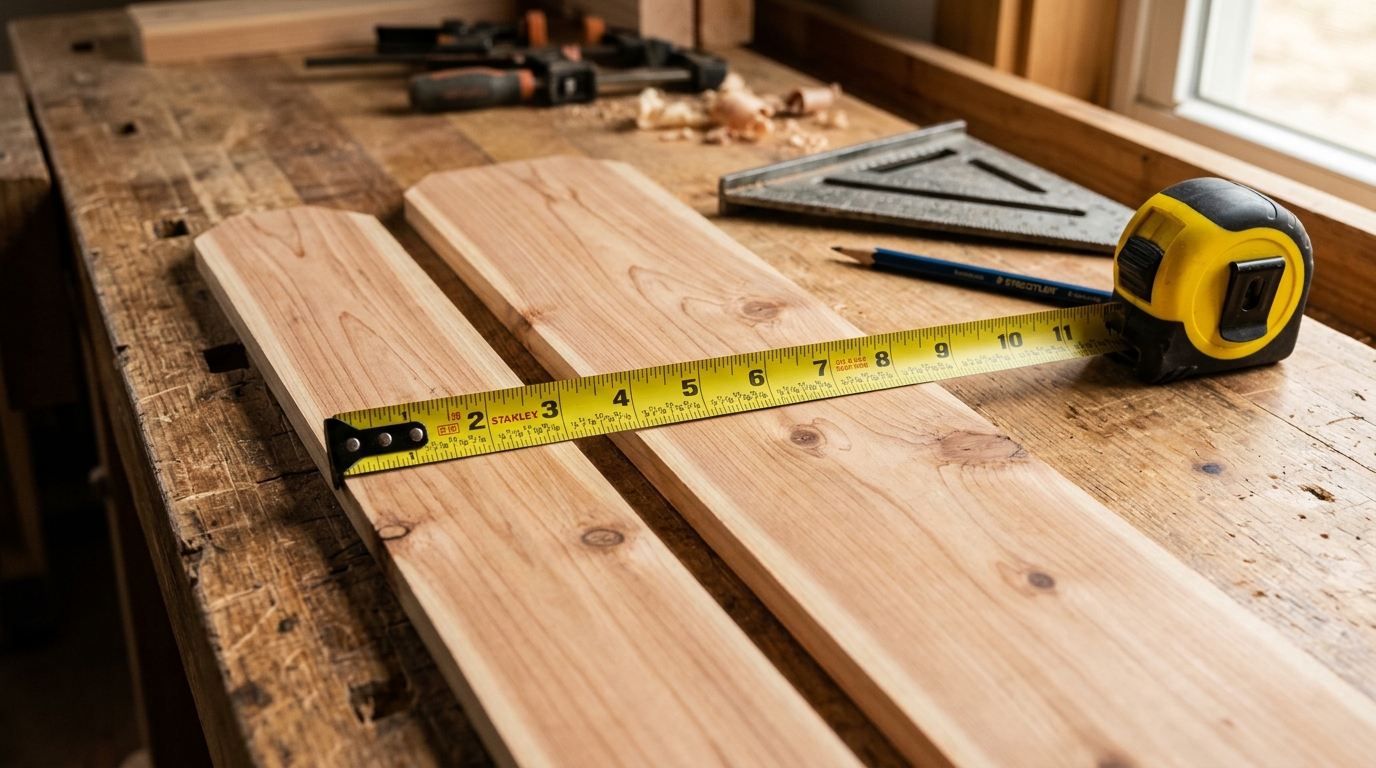
If you are planning a fence project, estimating materials, or replacing damaged boards, the exact width of your fence pickets is the single most critical measurement you need. Entering the wrong width into your calculations will leave you with awkward end gaps, uneven spacing, or a shortage of boards midway through construction.
So, how wide is a fence picket?
In North America, the two most common wood fence picket widths are:
- $1 \times 4$ Pickets: Actually $3.5\text{ inches}$ ($89\text{ mm}$) wide.
- $1 \times 6$ Pickets: Actually $5.5\text{ inches}$ ($140\text{ mm}$) wide.
However, many economy dog-ear pickets sold at major home centers (like The Home Depot and Lowe’s) actually measure $5\text{ and } 3/8\text{ inches}$ ($5.375\text{ in}$ / $137\text{ mm}$) wide.
In this comprehensive guide, we examine why labeled lumber dimensions differ from real-world measurements, compare $1 \times 4$ versus $1 \times 6$ boards, explore vinyl and metal picket widths, and explain how seasonal shrinkage affects your layout calculations.
1. Quick Reference: Standard Fence Picket Widths
Fence pickets vary depending on lumber mill dressing, profile design, and material choice. Here is the standard reference table comparing labeled (nominal) sizes against their real-world milled widths:
| Picket Style & Material | Labeled (Nominal) Size | Actual Milled Width | Actual Thickness | Typical Fence Application |
|---|---|---|---|---|
| Standard $1 \times 6$ Wood | $1”\times 6”$ | $5.5\text{ in}$ ($140\text{ mm}$) | $0.625”\text{ to } 0.75”$ ($16–19\text{ mm}$) | Full privacy fences, board-on-board, shadowbox |
| Economy Dog-Ear $1 \times 6$ | $1”\times 6”$ | $5.375\text{ in}$ ($5\text{-}3/8”$) | $0.625”$ ($16\text{ mm}$) | Budget residential privacy fencing |
| Standard $1 \times 4$ Wood | $1”\times 4”$ | $3.5\text{ in}$ ($89\text{ mm}$) | $0.625”\text{ to } 0.75”$ ($16–19\text{ mm}$) | Classic picket fences, cottage style, open spacing |
| Decorative $1 \times 3$ Wood | $1”\times 3”$ | $2.5\text{ in}$ ($64\text{ mm}$) | $0.5”\text{ to } 0.625”$ ($13–16\text{ mm}$) | Victorian, ornamental spear/gothic garden fences |
| Vinyl / PVC Privacy | $7/8”\times 6”$ | $6.0\text{ in}$ ($152\text{ mm}$) | $0.875”$ ($22\text{ mm}$) hollow | Zero-maintenance tongue-and-groove privacy |
| Vinyl Traditional Picket | $7/8”\times 3”$ | $3.0\text{ in}$ ($76\text{ mm}$) | $0.875”$ ($22\text{ mm}$) hollow | Traditional white picket fences with molded caps |
| Tubular Aluminum / Steel | $5/8”\text{ square}$ | $0.625\text{ in}$ ($16\text{ mm}$) | $0.625”\text{ square}$ | Pool safety barriers, modern security fencing |
| Commercial Aluminum | $3/4”\text{ square}$ | $0.75\text{ in}$ ($19\text{ mm}$) | $0.75”\text{ square}$ | High-traffic commercial perimeter fencing |
2. Nominal vs. Actual Lumber: Why a 6-Inch Picket Isn’t 6 Inches
The discrepancy between the size printed on a lumber yard label and what your tape measure shows comes down to standard sawmill finishing practices:
- Rough-Cut Stage (Green): When a raw log is first sliced into lumber at the sawmill, the saw blades cut the green, soaking-wet timber to roughly $1\text{ inch}$ thick by $6\text{ inches}$ wide. This is the nominal dimension.
- Drying & Planing (Surfaced Four Sides - S4S): Before reaching retail shelves, the lumber enters a drying kiln (or air-dries) to reduce moisture content. It is then run through high-speed rotary planing knives to smooth all four faces.
- Finished Product: The smoothing and curing process removes roughly $1/4\text{ to } 1/2\text{ inch}$ of wood fiber. The resulting board measures $5.5\text{ inches}$ wide and $0.625\text{ to } 0.75\text{ inches}$ thick.
Nominal Cut (Rough Sawmill): 1.0" x 6.0"
  ┌────────────────────────────────────────────────────────┐
  │                                                        │ 1.0"
  └────────────────────────────────────────────────────────┘
                           6.0"

After Drying & Rotary Planing (S4S Finished Picket): 0.625" x 5.5"
    ┌────────────────────────────────────────────────────┐
    │                                                    │ 0.625"
    └────────────────────────────────────────────────────┘
                          5.5"
[!WARNING]
Beware the Home Center 5-3/8” Picket Trap
In recent years, many high-volume lumber suppliers supplying big-box stores have milled dog-ear pickets to $5\text{ and } 3/8\text{ inches}$ ($5.375\text{ in}$) instead of the standard $5.5\text{ inches}$.
While an $1/8\text{ inch}$ ($0.125\text{ in}$) difference sounds negligible on a single board, over a standard 16-picket section, that $1/8\text{ inch}$ accumulates to a 2-inch layout discrepancy! Always verify the actual width of your boards with a tape measure before calculating gap spacing.
3. 1x4 (3.5”) vs. 1x6 (5.5”) Pickets: Which Width Should You Choose?
Selecting between $3.5\text{-inch}$ and $5.5\text{-inch}$ pickets shapes the visual appearance, wind resistance, material budget, and installation labor of your fence.
  [1x4 Picket: 3.5" Wide]             [1x6 Picket: 5.5" Wide]
     +---------------+                   +-----------------------+
     |               |                   |                       |
     |   3.5" Wide   |                   |       5.5" Wide       |
     |               |                   |                       |
     | Traditional   |                   | Full Privacy          |
     | Airy / Open   |                   | Fewer Boards / Run    |
     | Lower Wind    |                   | High Wind Load        |
     +---------------+                   +-----------------------+
Choosing 3.5-Inch ($1 \times 4$) Pickets
- Aesthetic Appeal: Ideal for traditional front-yard colonial fences, Cape Cod architecture, and classic white picket fencing.
- Wind Resistance: Narrower pickets separated by $1.5”\text{ to } 2.5”$ gaps allow gale-force winds to filter through easily, significantly reducing the lateral pressure exerted against your 4x4 posts.
- Weight: Lighter individual boards place less downward sagging load on your horizontal 2x4 rails.
- Drawback: Requires roughly $57%\text{ more pickets}$ to cover the same linear distance as $5.5\text{-inch}$ boards, which means more fasteners and longer installation times.
Choosing 5.5-Inch ($1 \times 6$) Pickets
- Aesthetic Appeal: The standard choice for $6\text{-foot}$ backyard privacy enclosures, board-on-board boundaries, and horizontal modern slat fences.
- Installation Speed: Because each picket covers $5.5\text{ inches}$ of frontage, you will install significantly fewer boards per 8-foot section (typically 14 to 17 boards versus 22 to 25 boards).
- Privacy: Leaves minimal or zero visual gap when installed edge-to-edge or in an overlapping shadowbox layout.
- Drawback: Solid fences built with $5.5\text{-inch}$ pickets act like sails in high wind storms, requiring deeply set posts anchored in high-strength concrete.
4. Alternative Materials: Vinyl, Metal, and Composite Widths
Wood is not the only option for modern fencing. Picket widths in non-wood materials adhere to different dimensional standards:
Vinyl / PVC Pickets
Extruded vinyl pickets are hollow structures engineered with interior reinforcing ribs.
- Standard 3-Inch Picket ($7/8”\times 3”$): Used for open ornamental front yard fences. They measure an exact $3.0\text{ inches}$ ($76\text{ mm}$) wide.
- Vinyl Privacy Slats ($7/8”\times 6”$): Typically measure an exact $6.0\text{ inches}$ ($152\text{ mm}$) wide and feature tongue-and-groove interlocking edges that slide together without gaps.
Aluminum and Steel Pickets
Metal fences utilize slim hollow square or rectangular balusters designed to provide strength without obstructing sightlines.
- $5/8\text{-Inch}$ ($16\text{ mm}$): Standard residential grade, commonly used around swimming pools and garden boundaries.
- $3/4\text{-Inch}$ ($19\text{ mm}$): Commercial grade, offering increased impact resistance and stiffness.
- $1\text{-Inch}$ ($25\text{ mm}$): Industrial security fencing.
Composite Pickets
Manufactured from wood flour and recycled high-density polyethylene (HDPE), composite boards are produced to precise tolerances. A nominal $1 \times 6$ composite picket generally measures an exact $5.5\text{ inches}$ wide and never requires staining or weather sealing.
5. Shrinkage & Expansion: How Moisture Changes Picket Width
One of the most overlooked realities of timber fencing is that a picket’s width changes after it is nailed to the fence rails.
Pressure-Treated Pine (PT Pine)
Pressure-treated lumber is injected with liquid preservatives under high pressure. When purchased fresh from the supplier, PT pine pickets are often saturated (“green”), with moisture content well above $20%$.
- As the hot sun bakes the boards over their first 6 to 12 weeks, the wood fibers dry and contract.
- A $5.5\text{-inch}$ wet board can shrink by $1/8\text{ inch to } 1/4\text{ inch}$ ($3–6\text{ mm}$) in width.
- If you butt wet pickets tightly edge-to-edge during installation, natural shrinkage will create visible $1/8”\text{ to } 1/4”$ gaps between each board within months.
Western Red Cedar & Redwood
Cedar and redwood have closed cellular grain structures and are typically sold dry or acclimated.
- Dimensional shrinkage is minimal—rarely exceeding $1/16\text{ inch}$ ($1.5\text{ mm}$).
- Cedar maintains its milled width reliably across seasonal humidity shifts.
Vinyl Thermal Expansion
Unlike wood, which expands when wet and shrinks when dry, vinyl pickets expand when hot and contract when cold:
- A standard vinyl picket can expand slightly in width and up to $1/4\text{ inch}$ in length during hot summer afternoons.
- Vinyl railing systems account for this with routed, oversized slot pockets that allow boards to slide freely without buckling.
6. How Picket Width Dictates Your Spacing Formula
The exact width of your picket is the foundational variable in calculating the spacing gap between boards.
When fencing an opening between posts, the formula for an even, balanced gap is:
$$\text{Uniform Gap} = \frac{\text{Post-to-Post Span} - (\text{Number of Pickets} \times \text{Actual Picket Width})}{\text{Number of Pickets} + 1}$$
Real-World Example
Suppose you have an 8-foot panel with an interior post-to-post span of $92\text{ inches}$, and you decide to install 14 pickets:
-
Scenario A: True $5.5\text{-inch}$ Cedar Pickets $$\text{Total Picket Width} = 14 \times 5.5” = 77.0”$$ $$\text{Remaining Space} = 92” - 77.0” = 15.0”$$ $$\text{Gap Width} = \frac{15.0”}{15} = \mathbf{1.0\text{ inch}}$$
-
Scenario B: Economy $5.375\text{-inch}$ ($5\text{-}3/8”$) Pickets $$\text{Total Picket Width} = 14 \times 5.375” = 75.25”$$ $$\text{Remaining Space} = 92” - 75.25” = 16.75”$$ $$\text{Gap Width} = \frac{16.75”}{15} = \mathbf{1.117\text{ inches}}; (\approx 1\text{-}1/8”)$$
That seemingly minor $1/8\text{ inch}$ board difference shifted your target spacer block from an even $1\text{ inch}$ to over $1\text{-}1/8\text{ inches}$. If you had cut a $1\text{-inch}$ spacer block blindly, you would have ended up with a massive, unsightly gap at the end post!
[!TIP]
Eliminate Job Site Guesswork
Avoid dividing awkward fractions on scrap wood. Open our free Fence Picket Calculator on your phone, enter your exact post-to-post distance and your measured picket width, and get instant board counts with clean tape-measure fractions.
7. How to Measure Your Pickets Before Installing
To ensure your fence build proceeds smoothly, follow this 4-step lumberyard inspection routine:
- Pull 3 Random Samples: Select boards from the top, middle, and bottom of the lumber bundle.
- Measure at the Midpoint: Measure across the face of the board with a steel tape measure. Check the width near both ends and across the center belly to verify there is no tapering or cup warping.
- Inspect for Milling Irregularities: Lay two boards edge-to-edge. Look for uneven mill planer marks or bark edges (wane) that reduce usable nailing surface.
- Group Similar Widths: If boards vary between $5\text{-}3/8”$ and $5\text{-}1/2”$, group identical widths together and use them on the same fence panel to preserve consistent spacing.
Frequently Asked Questions
What is the most common width for a fence picket?
The most widely used fence picket width in North America is $5.5\text{ inches}$ ($140\text{ mm}$), sold nominally as a $1 \times 6$ board. For traditional open picket fences, the most common width is $3.5\text{ inches}$ ($89\text{ mm}$), sold nominally as a $1 \times 4$.
Is a 1x6 fence picket really 6 inches wide?
No. Standard $1 \times 6$ lumber is surfaced down to an actual width of $5.5\text{ inches}$ ($140\text{ mm}$). Some budget dog-ear pickets sold at big-box home improvement stores are milled even narrower, measuring $5\text{ and } 3/8\text{ inches}$ ($5.375\text{ in}$).
Can you mix 3.5” and 5.5” pickets on the same fence?
Yes. Alternating between $3.5\text{-inch}$ and $5.5\text{-inch}$ pickets creates an attractive custom rhythm known as a varied-width or “hit-and-miss” fence. When doing this, calculate spacing based on the combined width of a repeating two-board pattern rather than a single board width.
How wide should the space between pickets be?
For privacy fences, spaces range from $0\text{ inches}$ (edge-to-edge) to $0.25\text{ inches}$ (to allow for wood expansion). For traditional decorative fences, spaces typically match the picket width or range between $1.5\text{ inches}$ and $2.5\text{ inches}$. Remember that local swimming pool barrier codes mandate that gaps must never exceed $4\text{ inches}$.
How thick is a standard fence picket?
Standard wood pickets range between $5/8\text{ inch}$ ($0.625\text{ in}$) and $3/4\text{ inch}$ ($0.75\text{ in}$) thick. Heavy-duty commercial pickets or clear cedar boards are typically a true $3/4\text{ inch}$ thick, whereas economy dog-ear pickets are usually $5/8\text{ inch}$ thick.
Related Guides & Tools
- Fence Picket Calculator — Enter your panel length and picket width for instant spacing and board counts.
- How Thick Is a Fence Picket? — Compare 5/8” vs 3/4” boards, nominal lumber rules, cupping prevention, and fastener depth.
- Standard Fence Picket Sizes & Dimensions — Explore standard picket lengths (4ft, 6ft, 8ft), profiles, and wood species.
- How Many Pickets for an 8-Foot Fence Panel? — Detailed breakdown of picket counts for 8ft sections across various widths.
- How to Space Fence Pickets Evenly — Step-by-step techniques for using spacer blocks and avoiding layout drift.
- Fence Picket Spacing Codes & Pool Regulations — Learn the 4-inch sphere rule and swimming pool enclosure compliance standards.