
The 8-foot fence panel (96 inches center-to-center or clear span) is the universal building block of North American residential fencing. Because standard horizontal 2x4 support rails are sold in 8-foot (96-inch) lengths, organizing your posts into 8-foot bays minimizes scrap cuts and labor.
However, asking “How many pickets do I need for an 8-foot fence panel?” depends on three critical parameters:
- Whether your picket is a $1\times4$ ($3.5\text{ in}$) or $1\times6$ ($5.5\text{ in}$) board.
- The desired privacy gap between boards ($0\text{ in}$ to $2.5\text{ in}$).
- Your edge layout: Equal Post Gaps vs Continuous Face-Mount.
Let’s examine the exact quantities for every standard combination.
1. Quick Reference Table: Pickets Per 8-Foot Section (96-Inch Clear Span)
Assuming standard Equal End Gaps across a 96.0-inch opening between 4x4 posts:
| Picket Size (Nominal) | Actual Width | Target Spacing Gap | Pickets Required | Resulting Exact Gap | Total Pickets (incl. 10% Waste) |
|---|---|---|---|---|---|
| $1 \times 4$ | $3.5\text{ in}$ | $1.5\text{ in}$ | $17\text{ pickets}$ | $2.03\text{ in}$ | 19 |
| $1 \times 4$ | $3.5\text{ in}$ | $2.0\text{ in}$ | $17\text{ pickets}$ | $2.03\text{ in}$ | 19 |
| $1 \times 4$ | $3.5\text{ in}$ | $2.5\text{ in}$ | $15\text{ pickets}$ | $2.72\text{ in}$ | 17 |
| $1 \times 6$ | $5.5\text{ in}$ | $1.5\text{ in}$ | $13\text{ pickets}$ | $1.75\text{ in}$ | 15 |
| $1 \times 6$ | $5.5\text{ in}$ | $2.0\text{ in}$ | $12\text{ pickets}$ | $2.31\text{ in}$ | 14 |
| $1 \times 6$ | $5.5\text{ in}$ | $2.5\text{ in}$ | $11\text{ pickets}$ | $2.96\text{ in}$ | 13 |
| $1 \times 6$ Solid Privacy | $5.5\text{ in}$ | $0.0\text{ in}$ (touching) | $17\text{ to } 18$ pickets | Flush butt joint | 19 to 20 |
[!NOTE] For a solid privacy fence where pickets touch edge-to-edge, divide total span by picket width: $$\frac{96\text{ in}}{5.5\text{ in}} = 17.45 \implies 17 \text{ full pickets plus 1 ripped board (2.5 inches wide)}.$$ Most carpenters install 17 full boards and slightly bevel or overlap them (board-on-board style).
2. Clear Opening vs On-Center Post Spacing
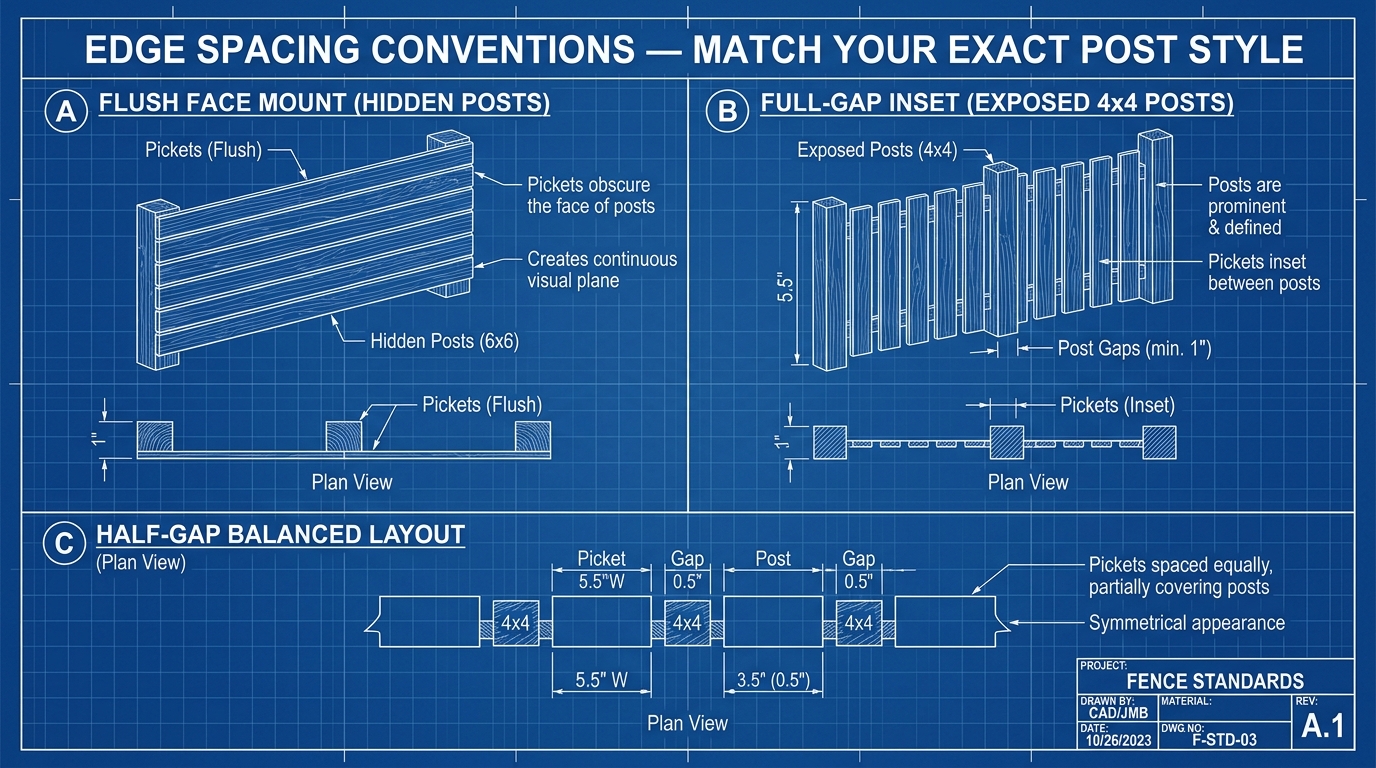
A common pitfall occurs when planning post holes.
- If you dig posts 96 inches on-center, and you use standard $4\times4$ posts (which actually measure $3.5\text{ in} \times 3.5\text{ in}$), the distance between post faces is:
$$96.0\text{ in} - 3.5\text{ in} = 92.5\text{ inches clear span}$$
- If you installed 8-foot horizontal rails between the posts, your clear span is $96.0\text{ inches}$.
Always measure the inside clear opening between post faces before running the calculation!
3. The Math for a Total Fence Run
Suppose your backyard fence requires 120 feet of total fencing:
Step 1: Convert to Panels
$$120\text{ ft} \div 8\text{ ft per panel} = 15\text{ panels}$$
Step 2: Choose Your Board Style
Using standard $1\times6$ Western Red Cedar ($5.5\text{ in}$ width) with an airy $2\text{ inch}$ gap:
- Each panel takes 12 pickets.
- Base order: $15\text{ panels} \times 12\text{ pickets} = 180\text{ pickets}$.
Step 3: Add Waste & Sorting Factor
Lumber bundles inevitably contain bowed boards, cracked tips, or resin knots that cannot be used. We recommend:
- Rectangular suburban yard (minimal cuts): Add 8% to 10%.
- Sloping terrain / stepped gates / angled lots: Add 12% to 15%.
For our 180-picket project: $$180 \times 1.10 = 198\text{ pickets}$$
Ordering 200 pickets guarantees you will not run short on installation day.
4. Test Your Exact Measurements
Do not guess fractional board widths. Open our interactive tool to calculate exact counts and visual layout:
- Ready to dig post holes, install rails, and hang pickets? See our full tutorial on How to Build a Picket Fence: Step-by-Step DIY Guide.
- Use the Fence Picket Spacing Calculator for instant imperial & metric calculations, waste factors, and custom printable layouts!