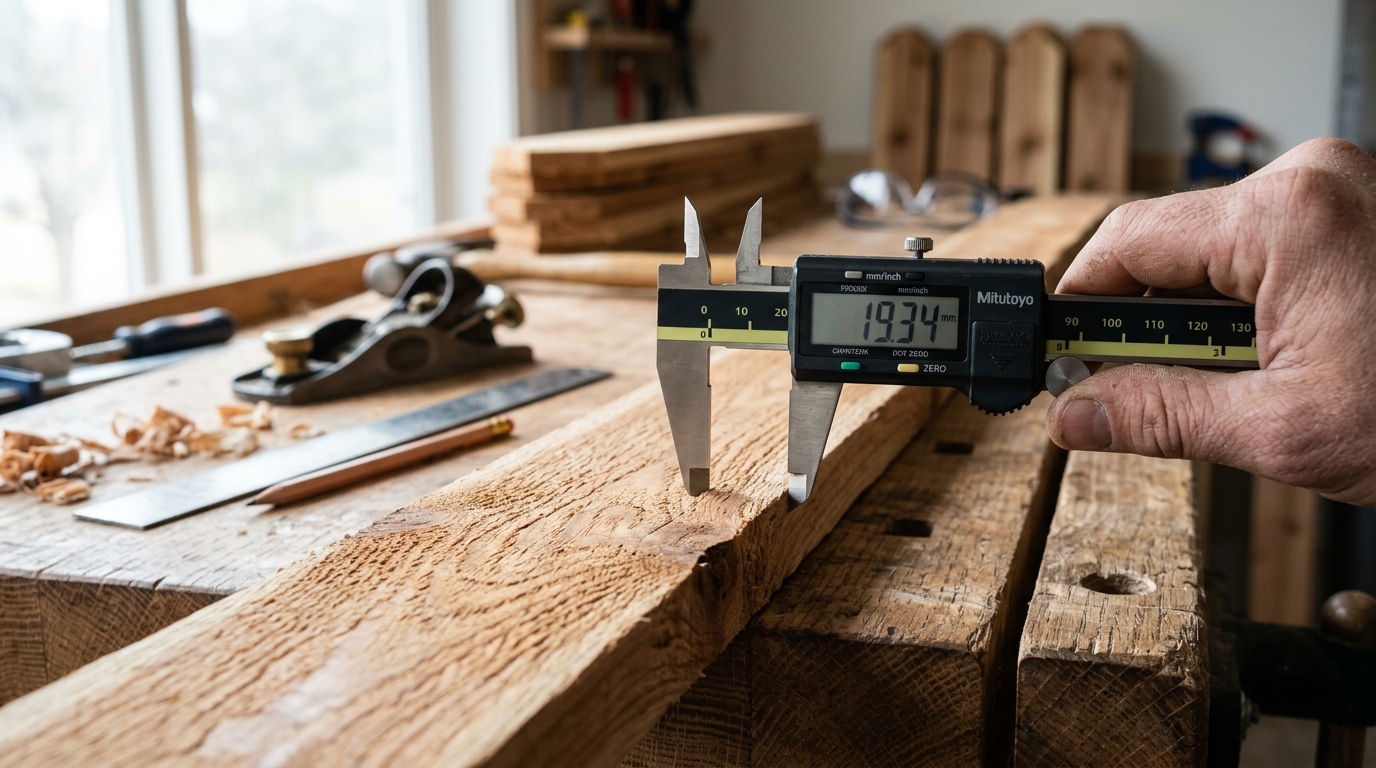
When shopping for fence pickets, most homeowners and contractors focus exclusively on width ($1 \times 4$ vs. $1 \times 6$) and height ($4\text{ ft}$, $6\text{ ft}$, or $8\text{ ft}$). Yet picket thickness is the single most decisive factor governing whether your fence stands straight for 20 years or buckles, cups, and splits after its first hot summer.
So, how thick is a fence picket?
In North America, standard wood fence pickets fall into two primary thickness tiers:
- Standard / Commercial Pickets: Actually $5/8\text{ inch}$ ($0.625\text{ in}$ / $15.88\text{ mm}$) thick. This is the thickness found on roughly $85%$ of residential dog-ear pickets sold at major home centers like The Home Depot, Lowe’s, and regional lumberyards.
- Heavy-Duty / Premium S4S Pickets: Actually $3/4\text{ inch}$ ($0.75\text{ in}$ / $19.05\text{ mm}$) thick. These are full-dimension surfaced boards commonly milled from Western Red Cedar, Redwood, or high-grade pressure-treated pine.
- Ultra-Budget / Thin Pickets: $1/2\text{ inch}$ to $9/16\text{ inch}$ ($12.7–14.3\text{ mm}$). Often sold in discounted economy bundles or used in prefabricated low-cost panels.
Non-wood alternatives have their own distinct profiles: extruded vinyl pickets measure $7/8\text{ inch}$ ($22\text{ mm}$) thick with hollow ribbed chambers, while tubular aluminum pickets are $5/8\text{ inch}$ or $3/4\text{ inch}$ square with wall gauges between $0.045”\text{ and } 0.060”$.
In this comprehensive technical guide, we break down nominal vs. actual thicknesses, compare $5/8\text{-inch}$ versus $3/4\text{-inch}$ performance in harsh climates, examine wood species differences, and explain how thickness dictates fastener selection and rail design.
1. Quick Reference: Fence Picket Thickness by Material & Grade
Fence picket thickness varies based on lumber mill surfacing, grading standards, and raw material. Here is how standard options compare across actual measurements, weight, and durability:
| Picket Style & Material | Nominal Label | Actual Thickness (Inches) | Actual Thickness (Metric) | Warp & Cup Resistance | Best Application |
|---|---|---|---|---|---|
| Standard Dog-Ear Wood | $1”\text{ nominal}$ | $5/8\text{ in}$ ($0.625”$) | $16\text{ mm}$ | Moderate | Standard residential privacy fences |
| Premium S4S Cedar / Redwood | $1”\text{ nominal}$ | $3/4\text{ in}$ ($0.750”$) | $19\text{ mm}$ | High / Exceptional | Custom residential, board-on-board, high wind areas |
| Rough-Sawn / Rustic Cedar | $1”\text{ nominal}$ | $11/16”\text{ to } 3/4”$ | $17.5–19\text{ mm}$ | High | Rustic privacy, shadowbox, unplaned natural texture |
| Economy / Budget Dog-Ear | $1”\text{ nominal}$ | $1/2”\text{ to } 9/16”$ | $12.7–14.3\text{ mm}$ | Low (prone to cupping) | Temporary boundary, rental property repairs |
| Vinyl / PVC Privacy Slats | $7/8”\text{ profile}$ | $7/8\text{ in}$ ($0.875”$) | $22.2\text{ mm}$ | Complete (UV stable) | Zero-maintenance interlocking privacy fencing |
| Vinyl Traditional Pickets | $7/8”\text{ profile}$ | $7/8\text{ in}$ ($0.875”$) | $22.2\text{ mm}$ | Complete (no rot) | Open front-yard decorative fencing |
| Composite Pickets (WPC) | $1”\text{ nominal}$ | $7/16”\text{ to } 5/8”$ | $11–16\text{ mm}$ | High (dense core) | High-end eco-friendly perimeter boundaries |
| Tubular Ornamental Aluminum | $5/8”\text{ square}$ | $5/8\text{ in}$ ($0.625”$) | $15.9\text{ mm}$ | Impervious to warping | Pool code barriers, security fences |
| Commercial Steel Balusters | $3/4”\text{ square}$ | $3/4\text{ in}$ ($0.750”$) | $19.1\text{ mm}$ | Maximum impact strength | Heavy-duty commercial perimeter fencing |
2. Nominal vs. Actual Thickness: Why “1-Inch” Boards Aren’t 1 Inch
Homeowners are often surprised to learn that a board labeled “$1 \times 6$” is nowhere near 1 inch thick. This difference is governed by standardized lumber milling practices:
- The Green Rough Cut: When freshly felled logs are sliced at the sawmill, blades cut green timber to an approximate $1.0\text{-inch}$ thickness. This raw dimension is the nominal size.
- Kiln Drying or Seasoning: As the lumber dries, moisture inside the wood cells evaporates, causing the wood fibers to shrink by $6%\text{ to } 10%$ in volume.
- Rotary Planing (Surfaced Four Sides - S4S): To ensure a smooth, splinter-free finish and uniform dimensions, boards pass through high-speed rotary planer knives.
Sawmill Rough Cut (Nominal Dimension): 1.0" Thick
  ┌──────────────────────────────────────────────────────────────┐
  │                                                              │ 1.0" (25.4 mm)
  └──────────────────────────────────────────────────────────────┘

Standard Framing Dimensional Lumber (1x4, 1x6 S4S): 0.75" Thick
    ┌──────────────────────────────────────────────────────────┐
    │                                                          │ 0.75" (19.05 mm)
    └──────────────────────────────────────────────────────────┘

Standard Retail Fence Picket (Specialty Fencing Mill): 0.625" Thick
      ┌──────────────────────────────────────────────────────┐
      │                                                      │ 0.625" (15.88 mm)
      └──────────────────────────────────────────────────────┘
Why Do Fence Pickets Finish at 5/8” Instead of 3/4”?
Standard dimensional lumber (like a $1 \times 6$ pine board used for interior shelving or fascia) planes down to $3/4\text{ inch}$ ($0.75\text{ in}$).
However, fence pickets are non-structural cladding boards. To reduce shipping freight weight, keep retail prices competitive, and maximize timber yield per log, commercial mills plane fence boards down to an industry-standard $5/8\text{ inch}$ ($0.625\text{ in}$). While $1/8\text{ inch}$ sounds slight, it reduces board weight by $16.7%$, saving significant transportation costs on bulk shipments.
3. Picket Cross-Section Comparison: 1/2” vs. 5/8” vs. 3/4”
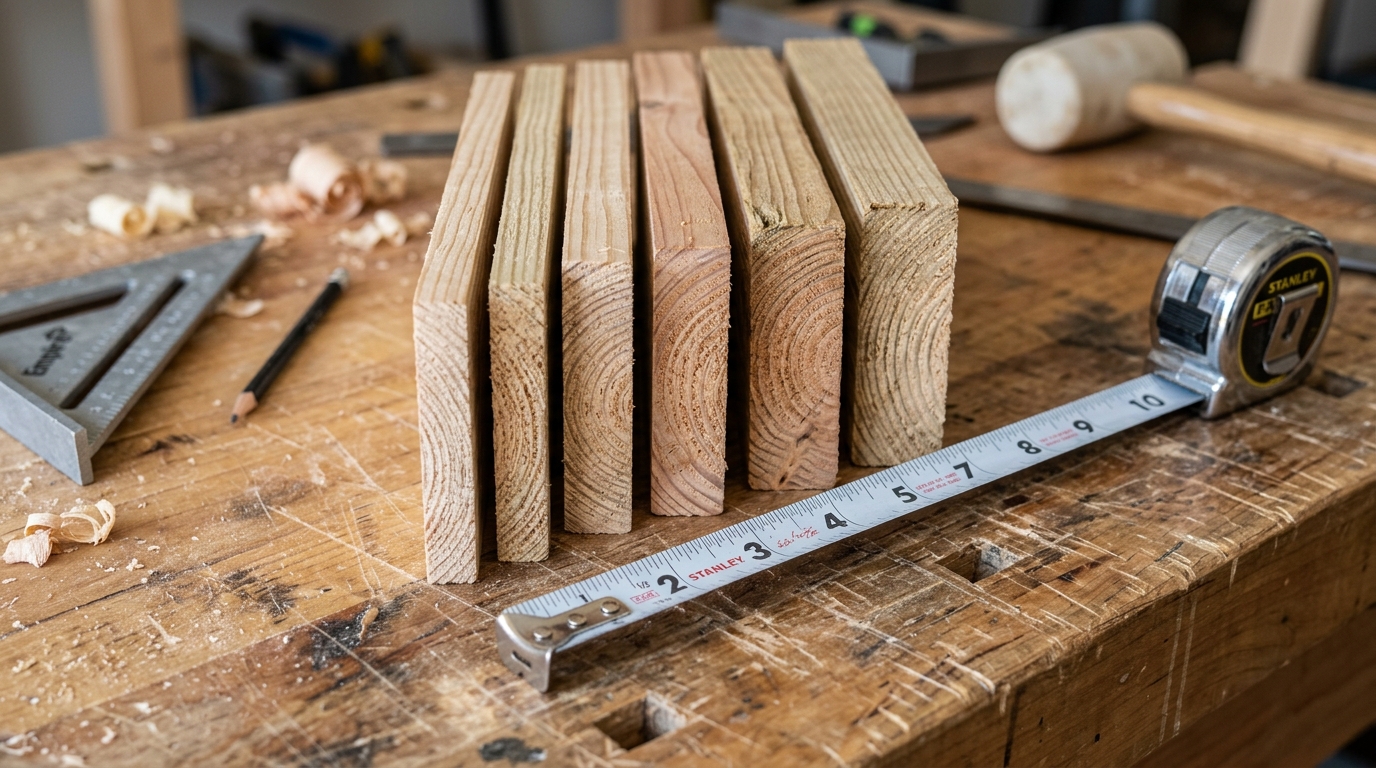
The thickness of your picket board dictates its mechanical strength, flexural rigidity, and resistance to environmental weathering.
1/2-Inch ($0.50\text{ in}$ / $12.7\text{ mm}$) — The Economy Risk
- Advantages: Extremely light, lowest upfront material cost.
- Risks: Prone to severe cupping (edges curling inward or outward) when exposed to morning humidity followed by afternoon direct sun.
- Fastener Failure: The thin wood membrane offers minimal bite for nail heads, making boards susceptible to popping loose or cracking along the grain during wind gusts.
- Lifespan: Typically 5 to 9 years before widespread board deformation occurs.
5/8-Inch ($0.625\text{ in}$ / $15.9\text{ mm}$) — The Residential Standard
- Advantages: The sweet spot between cost, weight, and functional durability. Compatible with standard $1\text{-}3/4”$ ring-shank fencing coil nails.
- Performance: When properly installed with 2 to 3 fasteners per rail crossing, $5/8\text{-inch}$ cedar or treated pine pickets deliver stable performance with minimal cupping.
- Lifespan: 12 to 18 years depending on species, maintenance, and climate exposure.
3/4-Inch ($0.750\text{ in}$ / $19.1\text{ mm}$) — The Premium Benchmark
- Advantages: Unmatched structural rigidity, superior acoustic deadening, and exceptional warp resistance.
- Performance: Virtually eliminates cupping and board splitting. Withstands high wind shear loads and accidental impacts from lawnmowers or pets.
- Lifespan: Easily surpasses 20 to 25+ years when paired with quality Western Red Cedar or Heart Redwood.
4. Why Picket Thickness Matters More Than You Think
Choosing between budget-thin pickets and heavy-gauge boards influences far more than initial purchase receipts:
  Thin Board (1/2" - 9/16")             Heavy Board (3/4" S4S)
  High heat & moisture                  Equalized tension

       \           /                         |           |
        \         /                          |           |
         \_______/                           |___________|
     Severe Face Cupping               Flat, True & Stable
   Pulls fasteners out of rail        Even seam gap maintained
1. Board Cupping and Warping
Wood shrinks and swells along three axes: longitudinal (length), radial (across growth rings), and tangential (along growth rings). Tangential shrinkage is roughly double radial shrinkage.
When a fence board’s exterior face bakes in $95^\circ\text{F}$ sun while its shaded interior face remains damp, the uneven drying exerts intense curling torque. A thin $1/2\text{-inch}$ board lacks the cross-sectional mass to resist this internal stress and cups dramatically. A $3/4\text{-inch}$ board has the torsional stiffness to remain flat.
2. Acoustic Privacy (Sound Transmission Class - STC)
A solid barrier cannot stop sound from traveling over a fence, but denser materials reduce sound passing directly through the wall. Sound transmission loss correlates directly with surface mass:
- A fence constructed with true $3/4\text{-inch}$ solid cedar boards reflects and attenuates substantially more low-frequency road rumble and neighborhood lawn equipment noise than a flimsy $1/2\text{-inch}$ fence.
3. Fastener Tear-Through in Windstorms
In gale-force winds, a solid privacy fence acts as a vertical sail. Wind generates positive pressure against the windward side and a powerful suction vacuum on the leeward face.
- On thin pickets, the wood surrounding nail heads can tear through under cyclical wind vibration.
- The extra wood fiber in a $5/8”\text{ or } 3/4”$ board holds ring-shank fastener heads securely embedded without pull-through.
5. Wood Species Breakdown: Actual Thickness & Moisture Behavior
Different timber species react differently to drying kilns and atmospheric humidity:
Western Red Cedar (WRC)
- Standard Surfaced (S4S): Usually milled to $5/8\text{ inch}$ ($16\text{ mm}$) or a true $3/4\text{ inch}$ ($19\text{ mm}$).
- Rough-Cut Cedar: Measures between $11/16\text{ inch}$ and $7/8\text{ inch}$.
- Moisture Behavior: Cedar has low shrinkage coefficients ($2.4%$ radial, $5.0%$ tangential). Its natural thujaplicin oils resist insect attack and rot without requiring artificial pressure chemical treatments.
Pressure-Treated Southern Yellow Pine (SYP)
- Milled Thickness: Labeled $1 \times 6$, but actually milled to $5/8\text{ inch}$ ($0.625\text{ in}$).
- The “Swollen Green” Phenomenon: Fresh pressure-treated pine is saturated with water-borne chemical solutions (like MCA or ACQ) and frequently exceeds $25%\text{ to } 30%$ moisture content.
- Straight off the delivery truck, a wet PT picket may measure $11/16\text{ inch}$ ($0.6875\text{ in}$) thick and $5\text{ and } 5/8\text{ inches}$ wide. As it dries over 6 to 10 weeks, it will shrink down to its true $5/8\text{-inch}$ thickness and $5.5\text{-inch}$ width.
Redwood
- Milled Thickness: Architectural grades are milled to $5/8\text{ inch}$ or $3/4\text{ inch}$.
- Moisture Behavior: Similar to cedar, redwood offers superb dimensional stability and minimal grain lift over time.
6. Fastener Selection & Nailing Depth by Picket Thickness
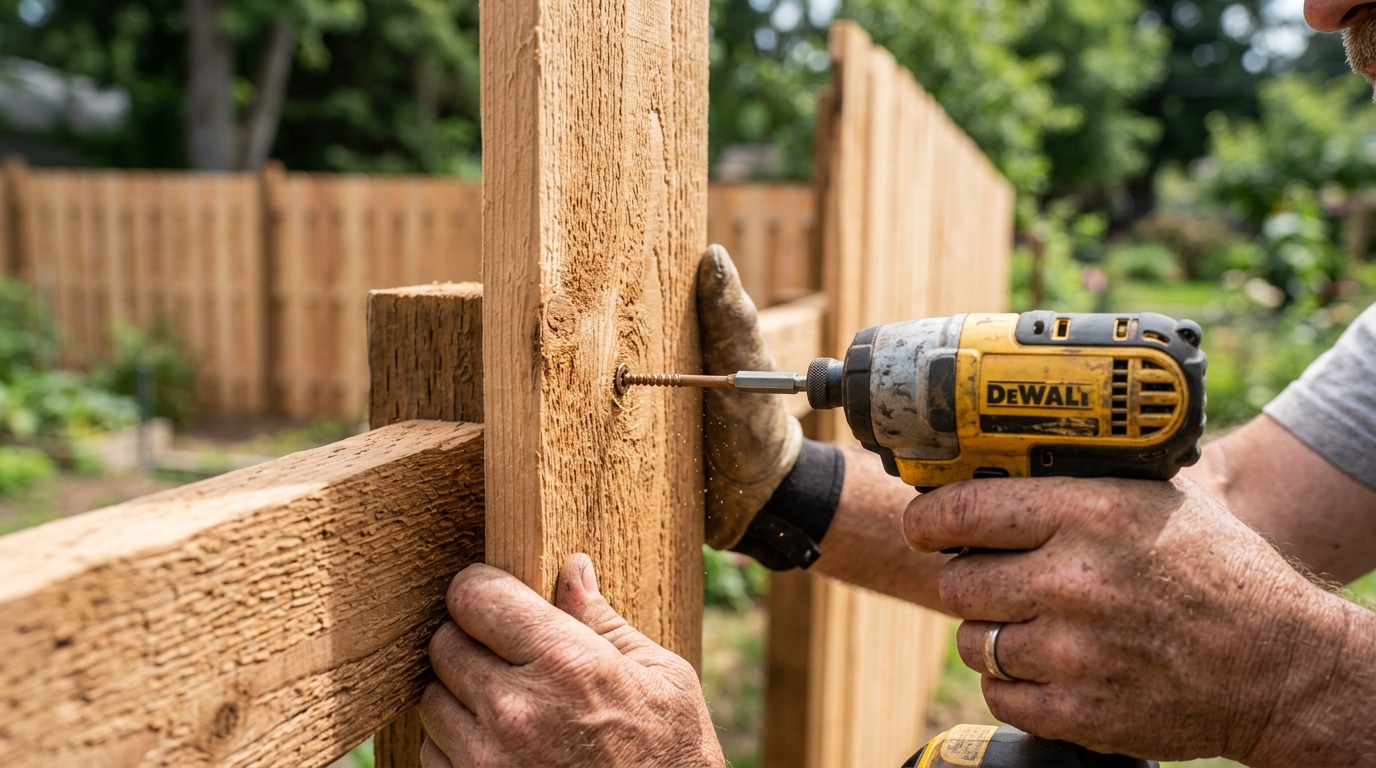
One of the most catastrophic construction errors is using the wrong length nail or screw for your picket thickness.
Your horizontal fence backing rails are standard $2 \times 4\text{ lumber}$, which has an actual thickness of $1.5\text{ inches}$ ($38\text{ mm}$).
If your fastener is too short, it will not penetrate deep enough into the rail to resist wind suction. If it is too long, the sharp tip will pierce through the backside of the rail, creating personal injury hazards and corrosion points.
Fastener Sizing Matrix
| Picket Thickness | Recommended Fastener Type | Recommended Length | Rail Penetration Depth | Notes |
|---|---|---|---|---|
| $1/2\text{ in}$ to $9/16\text{ in}$ | Hot-Dip Galvanized Ring-Shank Nail | $1\text{-}1/2\text{ in}$ ($38\text{ mm}$) | $1.0\text{ in}$ ($25\text{ mm}$) | Do not overdrive head; countersinking will punch through face |
| $5/8\text{ in}$ ($0.625”$) | 304/316 Stainless or HDG Ring Nail / Exterior Screw | $1\text{-}3/4\text{ in}$ to $1\text{-}7/8\text{ in}$ | $1.125\text{ to } 1.25\text{ in}$ | The golden standard for pneumatic fencing nailers |
| $3/4\text{ in}$ ($0.750”$) | 304 Stainless Ring Nail or #8 Exterior Wood Screw | $2\text{ in}$ to $2\text{-}1/4\text{ in}$ | $1.25\text{ to } 1.50\text{ in}$ | Maximum holding power; screws prevent wind creaking |
| $7/8\text{ in}$ Vinyl Slat | Self-Tapping Stainless Screws in U-Channel | $1\text{ in}$ to $1\text{-}1/4\text{ in}$ | Channel captive | Pickets slide into routed rail slots without face-nailing |
[!IMPORTANT]
The 2-Fastener Rule for Cupping Prevention
For standard $1 \times 6$ pickets ($5.5\text{ inches}$ wide), always use two fasteners per horizontal rail crossing, placed approximately $1\text{ inch}$ inward from each outside board edge. Never place a single fastener down the center of a wide board—the edges will curl upward like a potato chip within months!
7. How Picket Thickness Impacts Fence Framing & Rails
Picket thickness determines the dead load (weight) exerted on your fence posts and horizontal rails:
                  6-Foot Privacy Fence Panel (8-Foot Span)

  Weight with 5/8" Dry Cedar Pickets:    ~75 - 85 lbs  (2 rails acceptable, 3 better)
Weight with 3/4" Wet PT Pine Pickets: ~135 - 150 lbs (3 rails mandatory)- Two Rails vs. Three Rails:
- For fences $4\text{ feet}$ tall or shorter, two horizontal $2\times 4$ rails are sufficient.
- For $6\text{ foot}$ privacy fences, you should always install three horizontal rails (top, middle, and bottom). A middle rail prevents $5/8\text{-inch}$ and $1/2\text{-inch}$ pickets from twisting or flexing along their center span.
- Post Spacing and Depth:
- If installing heavy $3/4\text{-inch}$ pressure-treated pickets, reduce post spacing from $8\text{ feet}$ on center down to $6\text{ feet}$ on center in high-wind regions to support the extra weight.
8. Step-by-Step: How to Measure Picket Thickness Before Buying
Before loading bundles of pickets into your truck at the lumberyard, take five minutes to verify their dimensions:
- Bring a Digital Caliper or Pocket Rule: A standard tape measure is adequate for width, but measuring fractions under $1/16\text{ inch}$ on board edges is much faster and more accurate with a small digital caliper or 6-inch steel pocket rule.
- Inspect Multiple Bundles: Do not measure just the top board of a pallet. Slide boards out from the center and bottom of the pack.
- Measure Both Ends and the Middle: Check thickness near the top dog-ear cut, the center point, and the bottom end grain. Tapered boards indicate dull mill planer blades.
- Reject Severely Thinned Lumber: If pickets marketed as $5/8\text{ inch}$ measure under $0.50\text{ inch}$ ($1/2\text{ in}$), reject the bundle. The lumber was over-planed and will cup quickly once installed.
[!TIP]
Accurate Spacing Starts with Accurate Specs
Board thickness guarantees structural longevity, but accurate board width ensures perfect gaps. Use our free Fence Picket Calculator to plan your post spacing, calculate uniform gaps, and verify exact board counts before starting your build.
Frequently Asked Questions
What is the most common thickness for a wood fence picket?
The most widely used thickness for residential wood fence pickets in North America is $5/8\text{ inch}$ ($0.625\text{ in}$ / $15.9\text{ mm}$). This thickness is the default for dog-ear cedar, pressure-treated pine, and spruce privacy pickets sold at major home improvement retailers.
Why are 1x6 fence pickets only 5/8 inch thick instead of 3/4 inch?
While standard structural $1\times 6$ dimensional lumber planes down to $3/4\text{ inch}$ ($0.75\text{ in}$), fence pickets are non-bearing exterior siding. Specialty fencing mills intentionally plane them to $5/8\text{ inch}$ to save raw timber fiber, lower freight shipping weight, and provide affordable pricing for residential privacy fencing.
Is a 3/4” fence picket worth the extra money?
Yes, especially if you live in climates with extreme temperature swings, intense direct sunlight, or high wind gusts. True $3/4\text{-inch}$ pickets (often sold as premium clear cedar or heavy-duty S4S boards) resist cupping, warping, and splitting significantly better than $5/8\text{-inch}$ or $1/2\text{-inch}$ economy boards.
What length screws should I use for 5/8” fence pickets?
For $5/8\text{-inch}$ pickets attached to standard $2\times 4$ backing rails ($1.5\text{ inches}$ thick), use $1\text{-}5/8\text{ inch}$ to $1\text{-}7/8\text{ inch}$ exterior-coated deck screws or $1\text{-}3/4\text{ inch}$ stainless steel ring-shank fencing nails. This provides deep holding power without puncturing through the backside of the rail.
How thick are vinyl fence pickets?
Vinyl fence pickets typically measure $7/8\text{ inch}$ ($0.875\text{ in}$ / $22.2\text{ mm}$) thick. Unlike solid wood boards, vinyl pickets are hollow, extruded profiles engineered with internal structural web ribs and exterior wall thicknesses between $0.070\text{ and } 0.090\text{ inches}$.
Can you use 1-inch thick rough cut lumber for fence pickets?
Yes. Full-dimension rough-sawn lumber (often measuring an honest $1.0\text{ inch}$ thick) creates a remarkably durable, rustic fence. However, 1-inch thick green boards are heavy. You must use three heavy-duty horizontal $2\times 4$ rails and sink your $4\times 4$ or $6\times 6$ posts at least 3 feet deep into concrete footings to carry the substantial dead load.
Related Guides & Calculation Tools
- Fence Picket Calculator — Calculate exact picket counts, even board spacing, and post gaps in seconds.
- How Wide Is a Fence Picket? — Compare nominal vs. actual widths for $1\times 4$ and $1\times 6$ fence boards.
- Standard Fence Picket Sizes & Dimensions — Full breakdown of standard heights ($4\text{ft}$, $6\text{ft}$, $8\text{ft}$), profiles, and wood types.
- How Many Pickets for an 8-Foot Fence Panel? — Material estimations and board counts across common picket widths.
- How to Build a Picket Fence — Step-by-step master guide from digging post footings to setting rails and hanging pickets.
- Fence Picket Spacing Codes & Pool Regulations — Comply with international building codes and child-safety pool barrier standards.