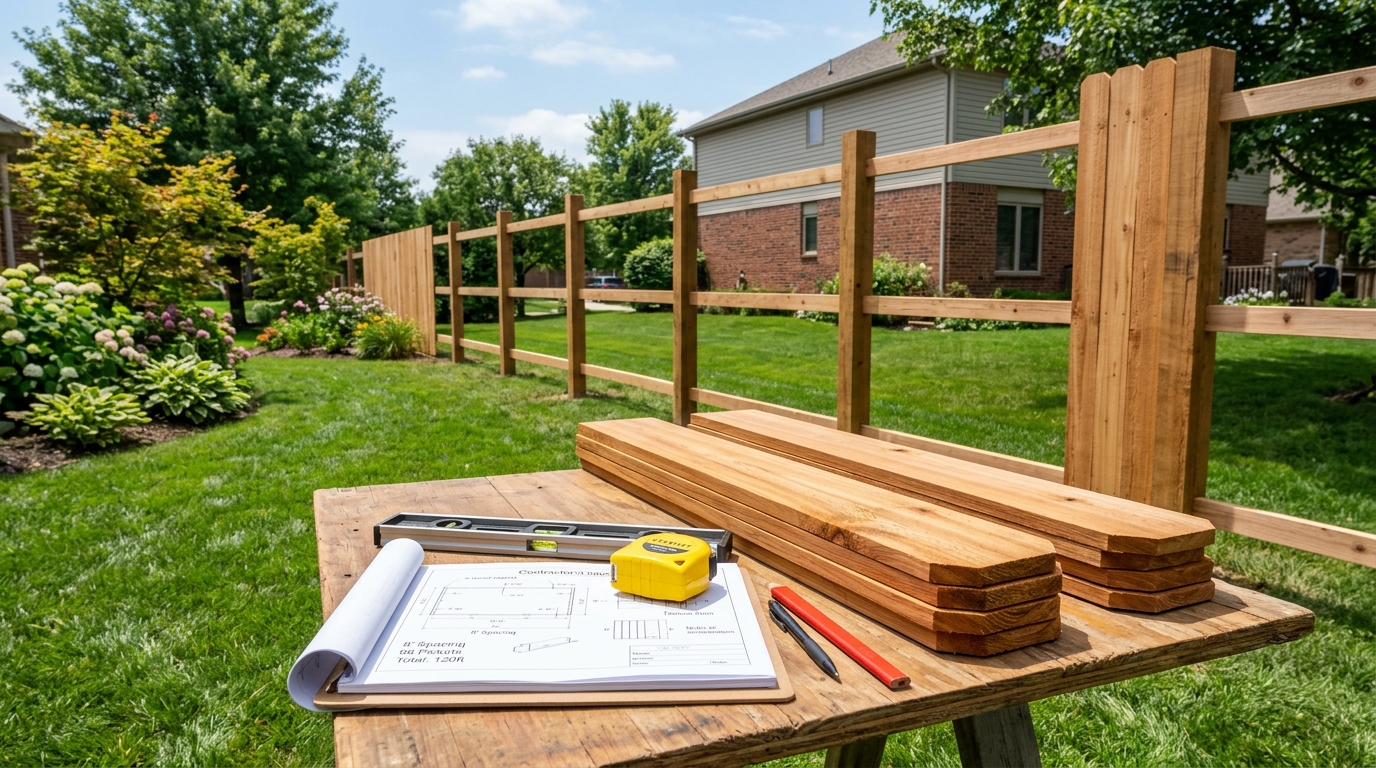
Whether you are enclosing a small suburban patio, fencing in a half-acre backyard for a energetic dog, or bidding on a commercial installation, the first question every property owner and carpenter asks is: “How many fence pickets do I actually need to buy?”
Underestimating your picket order leads to stalled projects, frustrating extra trips to the lumberyard, and color-mismatched wood batches. Overestimating leaves hundreds of dollars of warped, unused cedar or pressure-treated pine rotting in your driveway.
In this contractor reference guide, we give you the instant rule-of-thumb multiplier, the exact engineering formulas for every fence style, a complete 50-foot to 500-foot cheat sheet lookup table, and practical guidelines for wood shrinkage and lumber waste factors.
Quick Rule of Thumb: Instant Picket Multipliers
If you are standing in the aisle at The Home Depot or Lowe’s and need an instant, ballpark number before reading the detailed math, multiply your total linear footage by these contractor factors:
- Using Standard $1 \times 6$ Pickets ($5.5\text{ inches actual width}$):
- Solid Privacy (Touching edge-to-edge): Multiply total linear feet by $2.2$
- Spaced Picket ($2\text{-inch gap}$): Multiply total linear feet by $1.6$
- Board-on-Board (Overlapping privacy): Multiply total linear feet by $3.0$
- Using Standard $1 \times 4$ Pickets ($3.5\text{ inches actual width}$):
- Solid Privacy (Touching edge-to-edge): Multiply total linear feet by $3.5$
- Spaced Picket ($2\text{-inch gap}$): Multiply total linear feet by $2.2$
- Board-on-Board (Overlapping): Multiply total linear feet by $4.8$
[!IMPORTANT] Always add a $10%$ to $15%$ waste allowance on top of your final count to account for twisted, cupped, or knothole-damaged boards in bundled lumber.
1. The Three Formulas: How Fence Style Dictates Board Counts
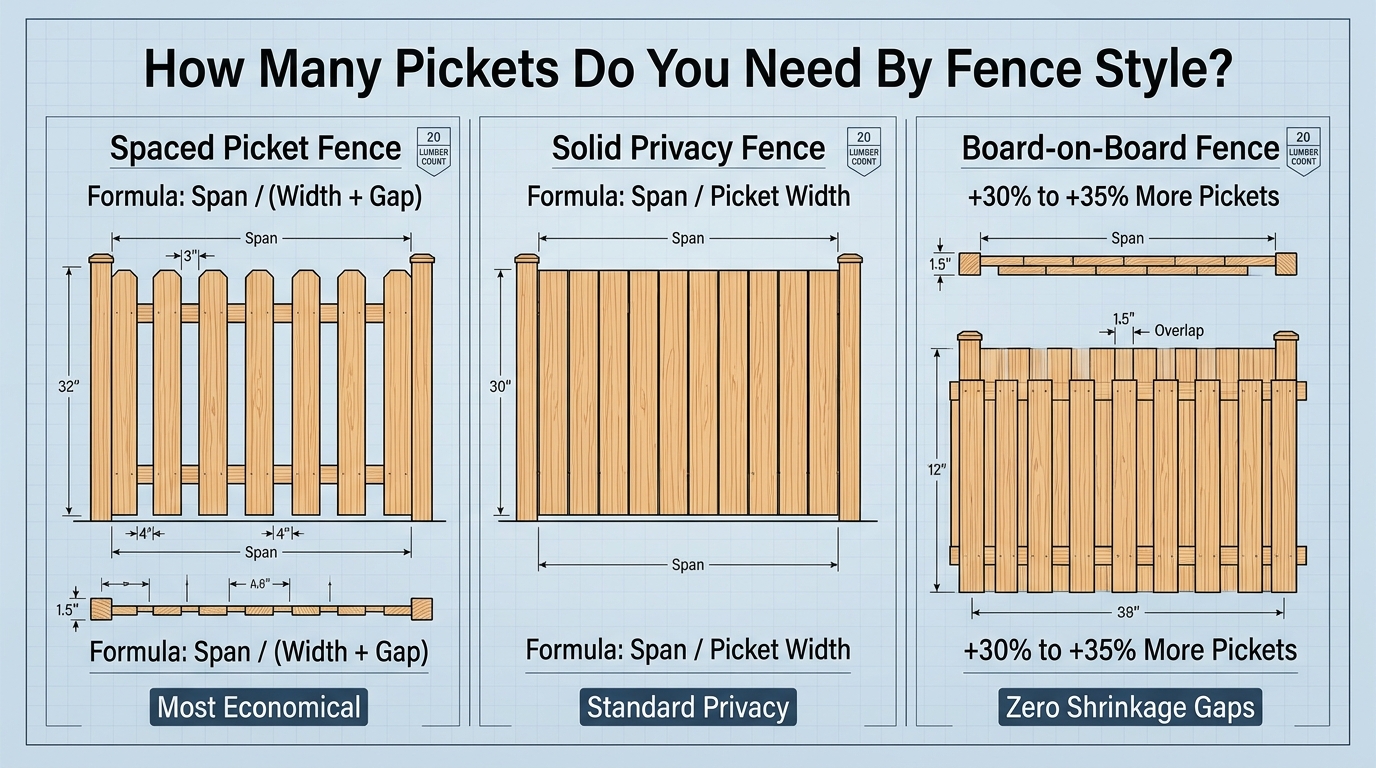
The number of pickets you need depends entirely on your fence design. A $100\text{-foot}$ perimeter built as an open front-yard picket fence requires roughly half the lumber of an overlapping board-on-board privacy fence:
Style 1: Spaced Picket Fence (Traditional Open Rhythm)
In an open picket fence, boards are separated by consistent gaps (typically $1.5\text{ to } 2.5\text{ inches}$) to allow light, air, and visibility:
$$\text{Pickets Needed} = \frac{\text{Total Run Length (in Inches)}}{\text{Actual Picket Width} + \text{Desired Gap Width}}$$
- Example: For an $8\text{-foot}$ ($96\text{-inch}$) panel using $1 \times 4$ boards ($3.5”\text{ actual}$) with a $2”\text{ gap}$: $$\frac{96\text{ in}}{3.5\text{ in} + 2.0\text{ in}} = \frac{96}{5.5} \approx 17.45 \implies 17\text{ or } 18\text{ pickets}$$
Style 2: Solid Privacy Fence (Edge-to-Edge Butt Joint)
In a standard residential privacy fence, pickets are mounted flush against each other with zero gap on the front face of the rails:
$$\text{Pickets Needed} = \frac{\text{Total Run Length (in Inches)}}{\text{Actual Picket Width}}$$
- Example: For a $100\text{-foot}$ ($1,200\text{-inch}$) fence using standard $1 \times 6$ boards ($5.5”\text{ actual}$): $$\frac{1,200\text{ in}}{5.5\text{ in}} \approx 218.18 \implies 219\text{ pickets (plus waste)}$$
Style 3: Board-on-Board Privacy (Shadowbox / Overlapping)
Board-on-board fencing is the gold standard for total privacy. Base pickets are installed with an intentional gap (typically $2.5\text{ to } 3.5\text{ inches}$), and an outer layer of pickets is nailed over the seams with an overlap of $1.0\text{ to } 1.5\text{ inches}$ on each side.
Because of the overlap, each $5.5\text{-inch}$ board provides only $4.0\text{ inches}$ of forward linear coverage:
$$\text{Effective Width} = \text{Actual Picket Width} - \text{Overlap}$$ $$\text{Pickets Needed} = \frac{\text{Total Run Length (in Inches)}}{\text{Effective Width}}$$
- Example: For a $100\text{-foot}$ ($1,200\text{-inch}$) run with $1 \times 6$ pickets and a $1.5”\text{ overlap}$: $$\text{Effective Width} = 5.5\text{ in} - 1.5\text{ in} = 4.0\text{ in}$$ $$\frac{1,200\text{ in}}{4.0\text{ in}} = 300\text{ pickets}$$ (Board-on-board requires approximately $37%$ more pickets than a standard butt-joint fence, but guarantees zero sightline gaps even when wet lumber shrinks).
2. Master Lookup Table: Pickets Needed by Fence Length
Here is your contractor cheat sheet for common residential fence lengths. The final column includes a $10%$ lumber waste allowance rounded up to standard retail bundle counts:
| Fence Length (Linear Feet) | $1 \times 6$ Solid Privacy ($5.5”$) | $1 \times 6$ Spaced ($2”\text{ Gap}$) | $1 \times 6$ Board-on-Board ($1.5”\text{ Overlap}$) | $1 \times 4$ Solid Privacy ($3.5”$) | $1 \times 4$ Spaced ($2”\text{ Gap}$) | Recommended $1 \times 6$ Solid Order (incl. 10% Waste) |
|---|---|---|---|---|---|---|
| $25\text{ ft}$ ($300”$) | $55$ | $40$ | $75$ | $86$ | $55$ | $61\text{ boards}$ |
| $50\text{ ft}$ ($600”$) | $110$ | $80$ | $150$ | $172$ | $110$ | $121\text{ boards}$ |
| $75\text{ ft}$ ($900”$) | $164$ | $120$ | $225$ | $258$ | $164$ | $181\text{ boards}$ |
| $100\text{ ft}$ ($1,200”$) | $219$ | $160$ | $300$ | $343$ | $219$ | $241\text{ boards}$ |
| $125\text{ ft}$ ($1,500”$) | $273$ | $200$ | $375$ | $429$ | $273$ | $301\text{ boards}$ |
| $150\text{ ft}$ ($1,800”$) | $328$ | $240$ | $450$ | $515$ | $328$ | $361\text{ boards}$ |
| $200\text{ ft}$ ($2,400”$) | $437$ | $320$ | $600$ | $686$ | $437$ | $481\text{ boards}$ |
| $250\text{ ft}$ ($3,000”$) | $546$ | $400$ | $750$ | $858$ | $546$ | $601\text{ boards}$ |
| $300\text{ ft}$ ($3,600”$) | $655$ | $480$ | $900$ | $1,029$ | $655$ | $721\text{ boards}$ |
| $400\text{ ft}$ ($4,800”$) | $873$ | $640$ | $1,200$ | $1,372$ | $873$ | $961\text{ boards}$ |
| $500\text{ ft}$ ($6,000”$) | $1,091$ | $800$ | $1,500$ | $1,715$ | $1,091$ | $1,201\text{ boards}$ |
3. Factoring in Posts, Corners & Gate Openings
Do you measure your fence from corner post to corner post, or do you have to subtract every single post? The answer depends on your mounting method:
    CONTINUOUS FACE-MOUNT                    INSET POST-TO-POST (PANEL)
   (Pickets run across post faces)          (Posts remain visible from exterior)

   [Picket][Picket][Picket][Picket]           [POST]  [Picket][Picket][Picket]  [POST]
   ===================================          ||    ========================    ||
      [POST]                 [POST]             ||              RAILS             ||
Scenario A: Continuous Face-Mount (Most Common for Privacy Fences)
In modern residential privacy fencing, the horizontal $2 \times 4$ rails are fastened to the face or side of the $4 \times 4$ posts, and the pickets are fastened continuously across the exterior.
- The rule: Do not deduct post widths. The pickets cover the posts completely. Simply use your property perimeter’s total linear footage.
Scenario B: Inset Panels (Posts Exposed)
In decorative architectural fencing, cedar posts are highlighted with post caps, and fence panels sit in between each post.
- The rule: Measure the clear distance between each set of posts, or subtract $3.5\text{ inches}$ (the actual width of a $4 \times 4$ post) for every intermediate post along the line.
Scenario C: Gate Openings
Always subtract gate openings from your total picket calculation unless you plan to build a matching custom wood gate out of the same pickets:
- Standard single pedestrian gate: Subtract $36\text{ to } 48\text{ inches}$ ($3\text{ to } 4\text{ feet}$).
- Double vehicle driveway gate: Subtract $96\text{ to } 120\text{ inches}$ ($8\text{ to } 10\text{ feet}$).
- If building a wood-clad gate, add $7\text{ to } 9$ pickets per $4\text{-foot}$ gate section.
4. The 10% to 15% Waste Factor (Why Exact Math Fails)
One of the most common mistakes amateur builders make is ordering the exact mathematical number of pickets. In the lumber industry, buying exact is running short.
Here is why professional fence contractors always add $10%$ (and up to $15%$ for big-box store economy packs):
- Natural Lumber Defects: In an economy bundle of 100 pressure-treated pine pickets, $5\text{ to } 8$ boards will have severe defects: excessive cupping, bowing, bark edges (wane), or loose knots that pop out when nailed.
- End-Cuts and Sloping Ground: On sloped yards where fences are “racked” or stepped, boards must be angle-cut at the bottom to maintain the proper $2\text{-inch}$ ground clearance. Miscuts happen.
- Future Replacement Stock: Wood fences face lawnmower impacts, weed-trimmer scarring, dog claws, and storm debris. Having $10\text{ to } 15$ matching dry pickets stored in your garage guarantees easy identical repairs 2 years from now without hunting for the same mill profile.
5. Wood Species & Moisture Shrinkage: Green vs. Kiln-Dried
Did you know that how many pickets you need can actually change after you nail them up? The culprit is wood moisture content:
- Wet Pressure-Treated Pine (PT): Freshly treated pine pickets bought from big-box stores are soaking wet with chemical preservative solutions, often holding over $30%$ to $50%$ moisture content. As they dry in the sun over their first $60\text{ to } 90\text{ days}$, each $5.5\text{-inch}$ board will shrink in width by $1/8”\text{ to } 1/4”$.
- If you butt green boards touching edge-to-edge ($0\text{-inch gap}$), they will naturally pull apart into a $1/4\text{-inch}$ gap as they season.
- Western Red Cedar (Kiln-Dried): Premium cedar is kiln-dried or air-seasoned prior to milling. It expands slightly during rainy winter months and contracts slightly in dry summer heat, but experiences negligible overall shrinkage.
[!TIP] If complete, permanent zero-sightline privacy is your priority, do not install green pine pickets edge-to-edge. Either use Board-on-Board construction (where shrinkage is absorbed by the overlap) or use kiln-dried Western Red Cedar.
6. Step-by-Step Worked Example: Calculating a 150-Foot Backyard
Let’s walk through a realistic, full-yard estimate:
- Total Property Line: $150\text{ linear feet}$ ($1,800\text{ inches}$).
- Gate Deductions: One $4\text{-foot}$ side gate ($48\text{ inches}$).
- Net Fence Run: $150\text{ ft} - 4\text{ ft} = 146\text{ linear feet}$ ($1,752\text{ inches}$).
- Chosen Material: $1 \times 6$ Dog-Ear Cedar Pickets ($5.5\text{ inches actual width}$).
- Fence Style: Solid Privacy (Face-mounted).
Step 1: Base Calculation
$$\text{Base Pickets} = \frac{1,752\text{ in}}{5.5\text{ in}} = 318.55 \implies 319\text{ pickets}$$
Step 2: Add Gate Cladding
Building the matching $4\text{-foot}$ gate ($48\text{ inches}$): $$\frac{48\text{ in}}{5.5\text{ in}} = 8.7 \implies 9\text{ pickets}$$ $$\text{Subtotal} = 319 + 9 = 328\text{ pickets}$$
Step 3: Add 10% Waste Factor
$$328 \times 1.10 = 360.8 \implies 361\text{ pickets}$$
Final Order: 361 boards (or approximately 6 bundles of 60 pickets).
7. Fastener & Rail Calculations
Once you know your picket quantity, calculating your supporting hardware is straightforward:
- Support Rails ($2 \times 4 \times 8\text{ft}$): Fences up to $4\text{ feet tall}$ require 2 horizontal rails per panel. Fences $6\text{ feet or taller}$ require 3 horizontal rails to prevent boards from warping. $$\text{Rails Needed} = \left(\frac{\text{Total Linear Feet}}{8}\right) \times 3$$
- Picket Fasteners (Nails / Screws): Use 2 fasteners per rail contact point (e.g., 6 screws per picket on a 3-rail 6-foot fence). $$\text{Total Screws} = \text{Total Pickets} \times 6$$ (For a 360-picket fence, you will need approximately $2,160$ exterior-coated or stainless steel screws—about two 5 lb boxes).
8. Frequently Asked Questions (FAQ)
How many pickets do I need for a 100-foot fence?
For a $100\text{-foot}$ ($1,200\text{-inch}$) solid privacy fence using standard $1 \times 6$ boards ($5.5”\text{ wide}$), you need 219 pickets. With a $10%$ waste allowance, order 241 pickets. If using $1 \times 4$ boards ($3.5”\text{ wide}$), you will need 343 pickets (order 378 with waste).
How many pickets come in a bundle or pallet?
At major home improvement retailers, dog-ear pickets are typically strapped into bundles of 16 to 20 boards. Full mill pallets (units) contain 400 to 500 pickets. Many lumberyards offer a bulk discount of $5%$ to $15%$ if you purchase full strapped units.
How many pickets do I need for an 8-foot fence panel?
An 8-foot ($96\text{-inch}$) clear span requires 17 to 18 pickets using $1 \times 6$ lumber for a solid privacy fence, or 12 to 13 pickets if spaced with a $2\text{-inch}$ gap. For a detailed breakdown of 8-foot bays, read our dedicated guide on How Many Pickets for an 8-Foot Fence Panel.
Is it cheaper to build with 1x4 or 1x6 pickets?
$1 \times 6$ pickets are almost always more cost-effective. While a $1 \times 4$ board has a lower price per unit, you need $57%$ more boards to cover the same distance, meaning significantly more labor, more measuring, and nearly double the number of fasteners.
Calculate Your Exact Fence Pickets Online
Don’t spend hours doing manual fraction math or risking rounding errors on expensive cedar lumber orders.
Use our free interactive Fence Picket Spacing Calculator to calculate:
- Exact picket counts for any panel or perimeter length
- Equal spacing gaps down to $1/16\text{ of an inch}$
- Visual real-time fence layout diagrams
- Complete printable material shopping lists with waste allowances included