When people hear the phrase “picket fence,” they almost always picture crisp white wooden slats lining a suburban front lawn, an manicured yard, or an afternoon DIY carpentry project. But in political science, constitutional law, and public administration, the picket fence is one of the most famous and enduring metaphors in modern American governance: Picket Fence Federalism.
Coined in the 1960s to capture the rapid transformation of the American system of government, Picket Fence Federalism explains how federal, state, and local governments interact not as isolated layers, but through deeply connected, highly specialized bureaucratic channels.
So, what is Picket Fence Federalism? How does the fence metaphor work, who came up with it, how does it compare to “layer cake” and “marble cake” federalism, and why does it still dictate how trillions of public tax dollars are spent today?
In this comprehensive guide, we dissect the architecture of Picket Fence Federalism—from its historical origins to real-world policy examples in transportation, healthcare, and education.
1. What Is Picket Fence Federalism? (Clear Definition)
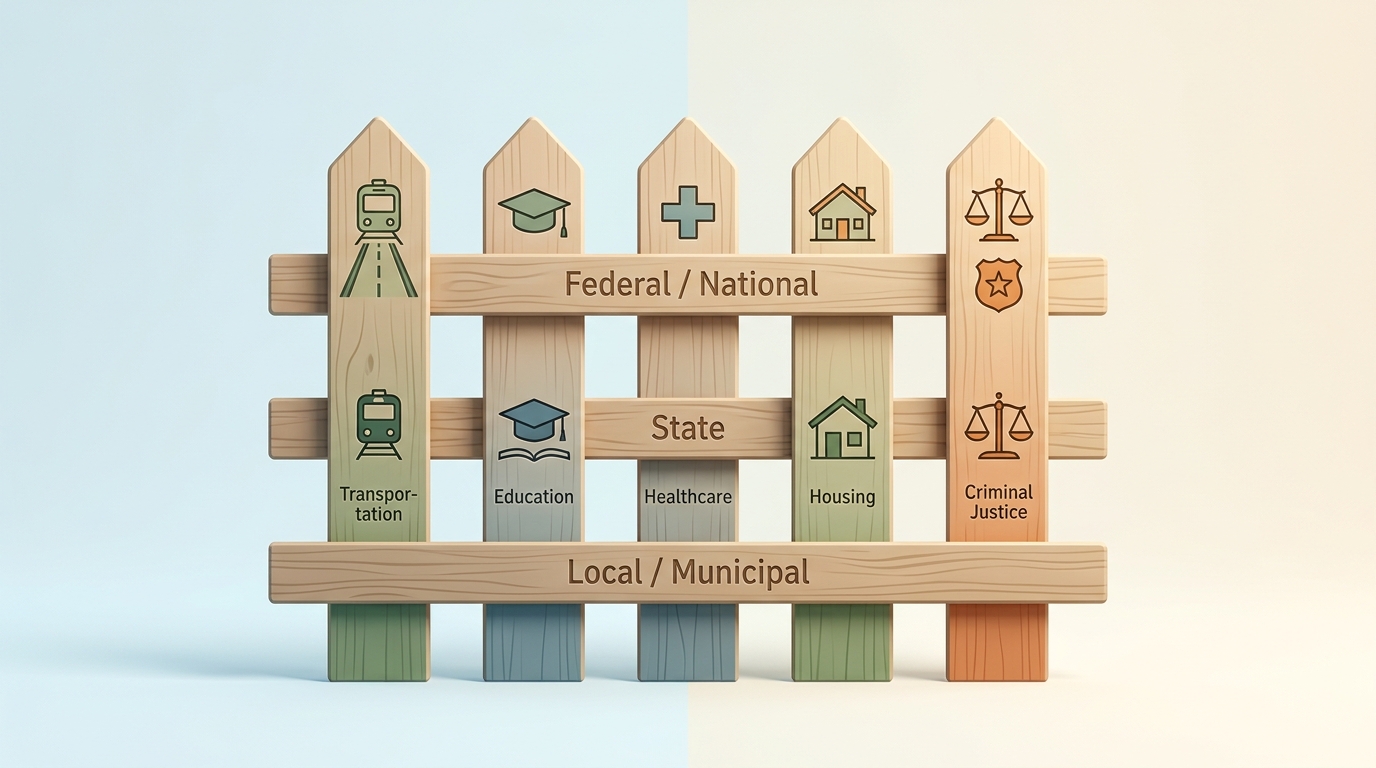
Picket Fence Federalism is a model of intergovernmental relations in which horizontal levels of government (national, state, and local) are connected by vertical policy areas (such as education, transportation, healthcare, housing, and public welfare).
In this system:
- The horizontal rails of the fence represent the three general levels of government: Federal, State, and Local.
- The vertical pickets represent specific functional policy domains staffed by career specialists, agency directors, and professional interest groups.
- The fasteners (nails or screws) represent federal grants-in-aid, regulations, and categorical funding streams that tie the pickets firmly to each level of government.
                  THE PICKET FENCE FEDERALISM MODEL

          [Highways]  [Education]  [Healthcare]  [Housing]  [Welfare]
              ||           ||           ||          ||          ||
  =========== || ========= || ========= || ======== || ======== || ===========  <-- TOP RAIL: Federal Government
              ||           ||           ||          ||          ||
  =========== || ========= || ========= || ======== || ======== || ===========  <-- MIDDLE RAIL: State Governments
              ||           ||           ||          ||          ||
  =========== || ========= || ========= || ======== || ======== || ===========  <-- BOTTOM RAIL: Local Governments
              ||           ||           ||          ||          ||
              \/           \/           \/          \/          \/
         Specialized Professional Alliances & Categorical Grants Flow Vertically
Under this framework, public health officials at the federal Centers for Disease Control and Prevention (CDC) work directly with state epidemiologists and county public health nurses. They share the same professional vocabulary, attend the same conferences, and manage the same grant programs.
In fact, these specialized bureaucrats often have far closer working relationships with their counterparts at other levels of government (along their vertical picket) than they do with the mayors, governors, or state legislators running the horizontal rails of their own government.
2. Anatomy of the Metaphor: Rails, Pickets & Fasteners
Just like a physical wooden fence relies on distinct structural members to stand firm, Picket Fence Federalism is built from three interdependent components:
1. The Horizontal Rails (General Government)
The horizontal rails represent general-purpose elected officials and legislative bodies:
- Top Rail (National / Federal): The President, Congress, and broad federal agencies.
- Middle Rail (State): State Governors and State Legislatures.
- Bottom Rail (Local / Municipal): Mayors, City Councils, and County Commissioners.
These elected leaders are responsible for balancing broad budgets, setting overarching policy agendas, and responding to voters across the entire community.
2. The Vertical Pickets (Functional Policy Specialists)
Each vertical picket represents an autonomous, highly specialized public sector domain. Examples include:
- Transportation & Infrastructure: Federal Highway Administration (FHWA) $\rightarrow$ State Department of Transportation (DOT) $\rightarrow$ County Road Commission.
- Public Education: U.S. Department of Education $\rightarrow$ State Board of Education $\rightarrow$ Local School Districts & Superintendents.
- Healthcare & Medicaid: Centers for Medicare & Medicaid Services (CMS) $\rightarrow$ State Health & Human Services $\rightarrow$ County Health Clinics.
- Housing & Urban Renewal: Department of Housing and Urban Development (HUD) $\rightarrow$ State Housing Finance Agencies $\rightarrow$ Local Municipal Housing Authorities.
- Environmental Protection: Environmental Protection Agency (EPA) $\rightarrow$ State Department of Natural Resources $\rightarrow$ Local Water Management Districts.
3. The Fasteners (Grants-in-Aid & Regulations)
A picket cannot hang in mid-air; it must be fastened to the rails. In political science, the fasteners are intergovernmental fiscal transfers:
- Categorical Grants: Federal funds earmarked exclusively for narrowly defined purposes (e.g., repairing bridges, funding school lunches, or administering childhood vaccinations).
- Federal Mandates & Conditions of Aid: Requirements that state and local governments must meet to receive federal funding (e.g., minimum drinking age laws, clean air benchmarks, or standardized testing).
3. The Evolution of Federalism Metaphors
To fully appreciate why Picket Fence Federalism became such a revolutionary concept, it helps to understand the culinary and architectural metaphors political scientists have used to describe the American republic throughout history:
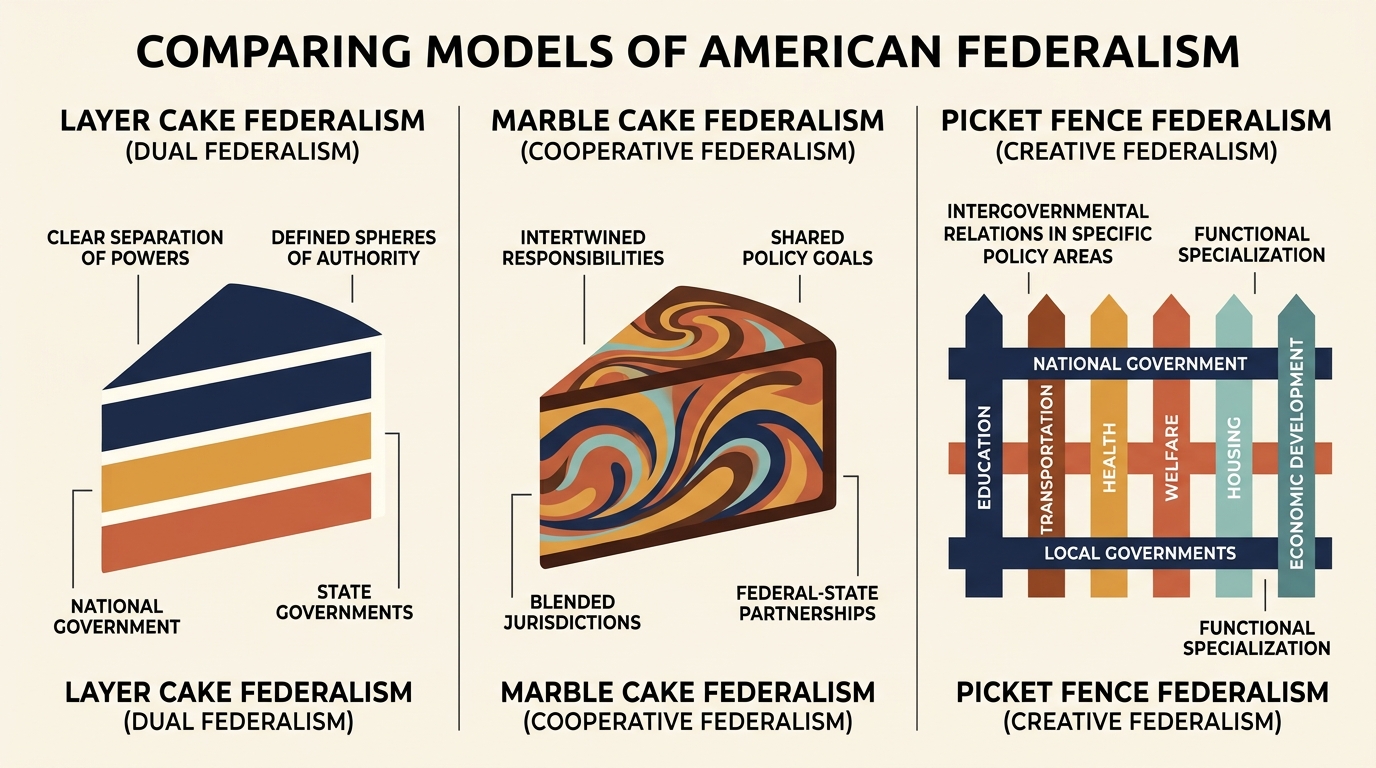
1. “Layer Cake” Federalism (Dual Federalism: 1789–1930s)
In the early days of the United States through the Great Depression, the constitutional order was viewed as Dual Federalism, famously described by political scientist Morton Grodzins as a Layer Cake:
- The top layer (National Government) exercised enumerated powers: national defense, foreign policy, treaties, tariffs, and currency.
- The bottom layer (State Governments) exercised reserved police powers: education, local crime, marriage, property, and civil law.
- Separation: Powers were distinct, separate, and non-overlapping. The federal government rarely intervened in matters reserved for the states.
2. “Marble Cake” Federalism (Cooperative Federalism: 1930s–1960)
When the Great Depression overwhelmed state and municipal relief funds, Franklin D. Roosevelt’s New Deal created a web of joint federal-state programs. Morton Grodzins noted that the layer cake had melted into a Marble Cake:
- Responsibilities, funding, and administrative duties became swirled and intermingled.
- State and federal agencies co-funded unemployment insurance, infrastructure projects, and agricultural subsidies.
- Distinct constitutional boundaries blurred into joint problem-solving.
3. “Picket Fence” Federalism (Creative Federalism: 1960s–1970s)
During Lyndon B. Johnson’s Great Society initiative, federal grant programs exploded in number and complexity. Rather than general cooperation, federal agencies began bypassing state governors and legislatures to channel categorical funding directly into specialized local agencies and non-profit coalitions.
Political scientists observed that “marble cake” was no longer descriptive enough. The system had become organized along rigid, vertical program silos—giving birth to the Picket Fence Federalism model.
Summary Comparison of Federalism Models
| Federalism Model | Era | Key Metaphor | Power Distribution | Primary Financial Mechanism |
|---|---|---|---|---|
| Dual Federalism | $1789 - 1930\text{s}$ | Layer Cake | Strict constitutional division between state & nation | Independent state & federal taxation; minimal grants |
| Cooperative Federalism | $1930\text{s} - 1960\text{s}$ | Marble Cake | Intertwined responsibilities; joint federal-state cooperation | Broad matching grants; shared New Deal funding |
| Picket Fence Federalism | $1960\text{s} - 1980\text{s}+$ | Picket Fence | Vertical programmatic silos driven by agency specialists | Specific categorical grants; federal guidelines & mandates |
| New Federalism | $1980\text{s} - \text{Present}$ | Devolution / Block | Attempts to return discretion to state governors and mayors | Block grants with fewer federal strings attached |
4. Who Coined “Picket Fence Federalism”?
The picket fence metaphor was first popularized by Terry Sanford, the former Governor of North Carolina (and later Duke University president and U.S. Senator), in his influential 1967 book, Storm Over the States.
Sanford served as governor during the height of the civil rights movement and early Great Society programs. He observed firsthand how federal bureaucrats in Washington, D.C., worked directly with specialized state and city agency heads, often keeping the Governor’s office completely in the dark:
“The lines of authority, the flow of money, and the directions of programs run straight down through each picket of the fence… The result is that the governor is often merely an observer of vast programs operating inside his own state borders.”
— Terry Sanford, Storm Over the States (1967)
Later, political scientist Deil S. Wright formally analyzed and systematized the concept in his landmark academic textbook, Understanding Intergovernmental Relations (1978). Wright demonstrated that as government grew increasingly technical and professionalized, specialized bureaucratic alliances—often called “sub-governments”, “iron triangles”, or “issue networks”—naturally formed along vertical lines of expertise.
5. Real-World Examples of Picket Fence Federalism
To understand how Picket Fence Federalism impacts everyday life, consider these real-world examples across three vital public systems:
Example 1: Interstate Highway Funding & Transportation
When a highway or bridge in your community needs replacement:
- Federal: The Federal Highway Administration (FHWA) provides $80%$ to $90%$ of the funding through the Highway Trust Fund.
- State: The State Department of Transportation (DOT) manages the engineering bids, environmental studies, and construction contracts.
- Local: The County or City Public Works Department coordinates lane closures, utility re-routing, and local traffic detours.
The civil engineers and transit planners at all three levels speak the exact same technical language, follow identical federal highway standards (such as AASHTO specifications), and work as a unified team along their vertical picket. If the mayor or governor wants to divert that federal highway money to hire more police officers, they cannot—the categorical funds are legally locked inside the transportation picket.
Example 2: Public School Education & Title I Grants
Under the federal Elementary and Secondary Education Act (ESEA / Every Student Succeeds Act):
- Congress allocates billions of dollars in Title I funds to assist schools with high percentages of low-income students.
- The U.S. Department of Education distributes the funds to the State Department of Education.
- State education administrators allocate the grants directly to Local School Districts, overseen by school superintendents and curriculum directors.
The vertical line of educators and testing coordinators controls how the money is spent. Local city councils and county mayors typically have zero jurisdiction over school board spending, preserving the educational picket’s independence.
Example 3: Medicaid & Public Health Infrastructure
Medicaid is the quintessential picket fence program:
- The Centers for Medicare & Medicaid Services (CMS) establishes federal eligibility guidelines and covers between $50%$ and $78%$ of medical costs through the Federal Medical Assistance Percentage (FMAP).
- The State Medicaid Directorate administers claims, contracts with managed care organizations, and reimburses healthcare providers.
- County Health Departments & Safety-Net Hospitals deliver primary care, manage community health clinics, and enroll eligible families.
Federal and state healthcare administrators coordinate closely to manage drug formularies, patient privacy regulations (HIPAA), and reimbursement rates, operating largely insulated from other municipal agencies.
6. Why Picket Fence Federalism Causes Political Friction
While Picket Fence Federalism promotes high professional standards, it also creates significant institutional headaches for elected leaders:
            THE "SILO EFFECT" IN LOCAL GOVERNANCE

   [Police Chief]          [School Supt.]         [Public Works Dir.]
        |                       |                         |
   (DOJ Grants)           (Title I Grants)          (DOT Grants)
        |                       |                         |
        +-----------------------+-------------------------+
                                |
                                v
               [Mayor / City Council in the Middle]
               * Lacks power to reassign funds
               * Trapped between federal rules
               * Blamed by voters for high taxes
1. The Bureaucratic “Silo Effect”
Because each picket operates as a self-contained vertical silo, agencies at the same horizontal level of government often fail to communicate with one another:
- A city transportation department may repave a boulevard on Monday, only for the municipal water authority to dig it up on Thursday to replace a water main.
- Urban development agencies might build affordable housing in an industrial zone without coordinating with the local school district to ensure there is adequate classroom capacity.
2. Disempowered Governors and Mayors
General elected officials—mayors, county executives, and governors—are held accountable by voters for the overall economic and social well-being of their communities. Yet under Picket Fence Federalism:
- A substantial portion of their state or city budget consists of federal grants that can only be spent on pre-approved activities.
- Agency directors often look to their federal grant officers for instructions rather than taking orders from the mayor or governor.
- When budget crises strike, governors cannot easily shift surplus funds from a federal highway program to fill a deficit in emergency child welfare services.
3. Iron Triangles & Special Interest Capture
Within each vertical picket, three powerful players form what political scientists term an “Iron Triangle”:
- The Executive Agency: Career federal and state program managers.
- The Congressional Committee: Legislative subcommittees that control the agency’s appropriations.
- Organized Interest Groups: Professional associations, trade unions, and contractor lobbies (e.g., highway builder associations, teachers’ unions, medical hospital lobbies).
These three groups develop mutually reinforcing relationships that protect their programmatic picket against budget cuts or reform efforts proposed by outside elected leaders.
7. Structural Pros and Cons: A Balanced Breakdown
Like any governance structure, Picket Fence Federalism involves distinct engineering tradeoffs:
| Structural Feature | Benefits (The Upside) | Drawbacks (The Downside) |
|---|---|---|
| Professional Specialization | Programs are designed and executed by trained subject-matter experts (engineers, doctors, educators), not political appointees. | Technocrats become insulated from public feedback and democratic oversight. |
| National Minimum Standards | Guarantees that civil rights, environmental safety, and school nutrition meet consistent baseline standards across all 50 states. | Imposes rigid “one-size-fits-all” federal mandates that may not suit rural or unique local communities. |
| Dedicated Funding Streams | Protects vital public health and infrastructure funds from being raided by politicians during election-year budget cycles. | Prevents local governments from flexibly redirecting revenue to meet sudden, urgent community needs. |
| Intergovernmental Continuity | Career agency personnel maintain long-term institutional knowledge that survives changes in political administrations. | Creates entrenched administrative red tape and duplicate paperwork across federal, state, and local agencies. |
8. The Architectural Lesson: What Real Fences Teach Us About Governance
The durability of the “picket fence” metaphor in political science is no coincidence. In woodworking and fence building, structural integrity depends entirely on the correct relationship between horizontal rails and vertical pickets:
- If the horizontal rails are too weak: The fence sags under its own dead weight, bowing in the middle and causing the pickets to twist out of plumb. In governance, when horizontal elected leadership (governors, mayors) lacks authority, programs become chaotic, uncoordinated, and unaccountable.
- If the vertical pickets are spaced too tightly: Wind cannot pass through the fence. During a severe storm, the fence acts like a solid sail, generating extreme wind load that snaps posts off at ground level. In governance, when vertical policy silos become completely airtight, communication between agencies ceases, and the entire public administration fractures under stress.
- If the fasteners are cheap or missing: The pickets detach and fall off the stringers after a single season of thermal expansion. In federalism, without transparent, reliable intergovernmental funding agreements, partnerships between Washington and local municipalities disintegrate.
Whether you are designing a front yard cedar perimeter or analyzing constitutional intergovernmental relations, balance, spacing, and strong connections are what keep the structure standing straight.
9. Frequently Asked Questions (FAQ)
What is the difference between marble cake and picket fence federalism?
Marble Cake Federalism describes the broad mingling of state and federal responsibilities, emphasizing cooperative problem-solving without strict constitutional barriers. Picket Fence Federalism is a more specific critique of the system after 1960, highlighting that cooperation does not happen randomly like marbled batter; instead, it happens inside rigid, vertical, functional silos (education, transportation, healthcare) where specialists communicate directly across levels of government, bypassing general elected leaders.
Who coined the term “Picket Fence Federalism”?
Former North Carolina Governor Terry Sanford first coined the term in his 1967 book Storm Over the States to describe how federal grant programs circumvented governors’ authority. Political scientist Deil S. Wright later expanded and popularized the concept in academic literature on intergovernmental relations.
Does Picket Fence Federalism still exist today?
Yes. Although efforts at “New Federalism” and devolution under Presidents Richard Nixon, Ronald Reagan, and Bill Clinton consolidated some categorical grants into flexible block grants, the vast majority of federal domestic spending still flows through specialized vertical program pickets—most notably in transportation, Medicaid, clean water infrastructure, and public education.
What are categorical grants, and why are they critical to the picket fence model?
Categorical grants are federal funds designated for narrow, specific purposes with stringent spending rules attached (e.g., funding specialized airport runway repaving or childhood lead screening). They are the “screws and nails” of Picket Fence Federalism because they bind local and state program administrators directly to federal agency guidelines, preventing state and local politicians from reallocating the money elsewhere.
Explore More Fence Building & Spacing Resources
Curious about how actual wooden pickets, stringers, and post footings come together on residential properties? Explore our carpentry guides and contractor tools:
- Learn the structural anatomy of real boundary fences in What Is a Picket Fence? The Complete Homeowner & Builder Guide.
- Check standard board widths, thicknesses, and lumber grades in Standard Fence Picket Sizes & Dimensions.
- Calculate the exact number of boards and gap widths for your next outdoor project with our free interactive Fence Picket Spacing Calculator!