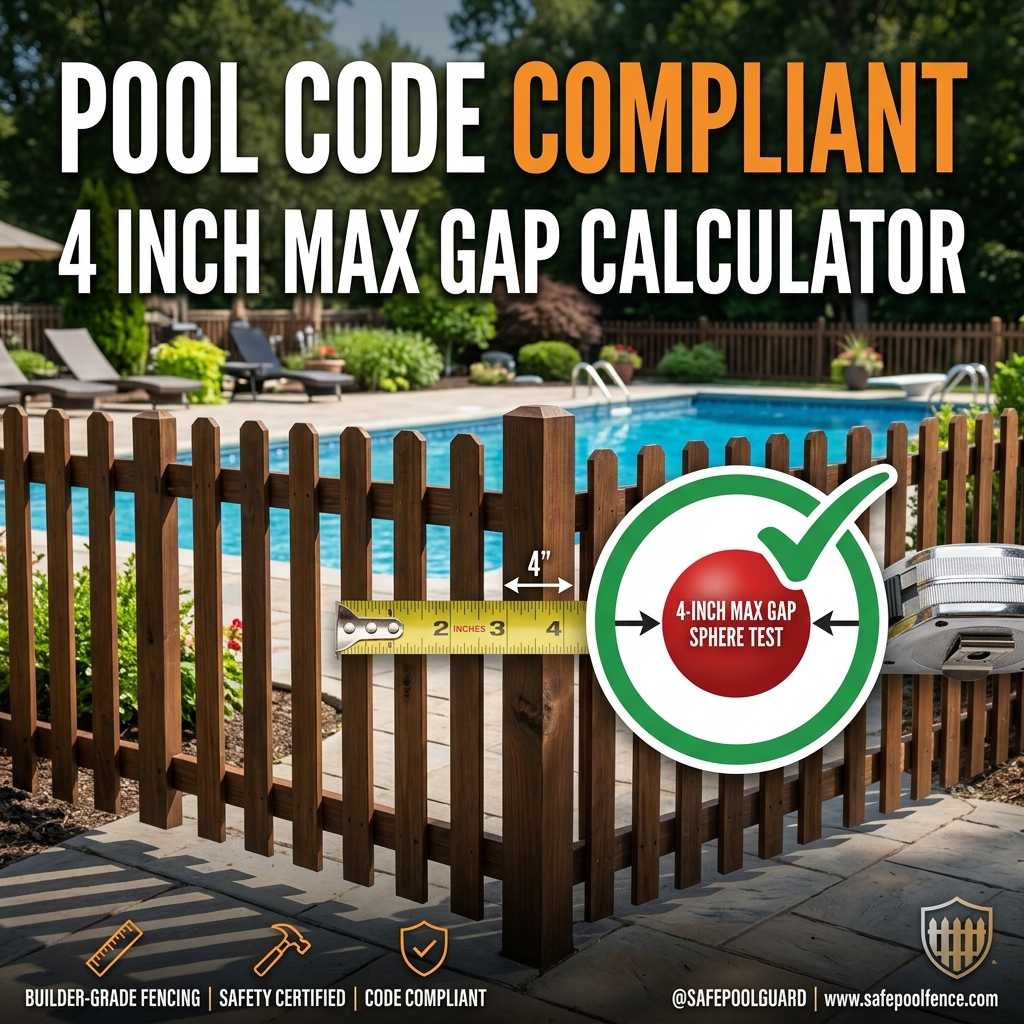
When building or replacing a picket fence, compliance with local municipal codes and international building standards is essential. Violating spacing codes can lead to failed municipal inspections, expensive tear-downs, and severe safety liabilities—especially around swimming pools.
The most widely adopted building standard in North America is the International Residential Code (IRC), along with BOCA (Building Officials and Code Administrators) model pool barrier codes.
Here is what every property owner and contractor must know regarding fence picket spacing limits.
1. The 4-Inch Sphere Test (IRC & Pool Barrier Rule)
The most famous rule in residential fence code is the 4-inch sphere test:
“Openings in the barrier shall not allow the passage of a 4-inch-diameter (102 mm) sphere.”
— IRC Section AG105 / ISPSC (International Swimming Pool & Spa Code)
       Picket        Gap         Picket
     +--------+    (Max 4")    +--------+
     |        |   +--------+   |        |
     |        |   | 4-inch |   |        |
     |        |   | Sphere |   |        |
     |        |   | (Pass) |   |        |
     |        |   +--------+   |        |
     |        |                |        |
Why 4 Inches?
The 4-inch standard is scientifically established based on the torso and head dimensions of small children (ages 6 months to 4 years). If an opening allows a 4-inch sphere to pass through, a toddler could squeeze through or become trapped by their head or torso.
What Does This Mean for Your Picket Spacing?
- For pool barriers and safety fences, your calculated equal gap $g$ must be less than $4.0\text{ inches}$ ($102\text{ mm}$).
- In practice, contractors aim for $3.5\text{ inches}$ to $3.75\text{ inches}$ maximum to account for wood shrinkage or warping over time. If a gap expands to $4\text{ and } 1/16\text{ inches}$ as lumber dries, an inspector’s 4-inch ball tester will slip through, failing the inspection!
2. Horizontal Rail Separation (Climbing Resistance)
It is not enough for pickets to be spaced less than 4 inches apart; the structure must also be non-climbable:
- When horizontal rails are on the outside (spaced less than 45 inches apart):
- The pickets must be spaced no wider than $1.75\text{ inches}$ ($44\text{ mm}$) apart.
- Reason: If rails are closer than 45 inches, children can use the rails as a ladder. Tight picket gaps prevent footholds.
- When horizontal rails are spaced 45 inches or more apart:
- Picket gaps may be up to the standard $4.0\text{ inches}$ maximum.
3. Bottom Clearance (Ground to Picket Bottom)
Another common inspection failure is the distance between the ground surface and the bottom edge of the pickets:
- Standard Lawn / Grass: Maximum $2.0\text{ inches}$ to $4.0\text{ inches}$ clearance.
- Pool Barrier on Hard Surface (Concrete/Pavers): Maximum $2.0\text{ inches}$ ($51\text{ mm}$).
- Pool Barrier on Turf / Dirt: Maximum $2.0\text{ inches}$ to prevent children from lifting or crawling beneath the fence.
4. Minimum Fence Heights by Application

| Fence Type | Typical Minimum Height | Standard Picket Gap | Key Inspection Focus |
|---|---|---|---|
| Swimming Pool Enclosure | $48\text{ inches}$ ($122\text{ cm}$) | $< 4.0\text{ in}$ ($102\text{ mm}$) | Self-closing/self-latching gate opening outward |
| Front Yard Property Line | $36\text{ to } 48\text{ in}$ | $1.5\text{ to } 3.5\text{ in}$ | Sight triangle at driveway corners |
| Backyard Boundary | $72\text{ inches}$ ($183\text{ cm}$) | $0\text{ to } 2.5\text{ in}$ | HOA guidelines & setback boundaries |
| Deck / Balcony Railing | $36\text{ to } 42\text{ in}$ | $< 4.0\text{ in}$ (strict) | 200 lb concentrated lateral load resistance |
5. Pool Gate Requirements
If your picket fence includes an access gate:
- Must swing outward away from the pool area.
- Must be equipped with a self-closing spring hinge.
- The latch release must be installed at least $54\text{ inches}$ above the bottom of the gate, or placed on the poolside of the fence at least 3 inches below the top with no openings greater than 0.5 inches within 18 inches of the latch.
Calculate Safe, Code-Compliant Spacing
To ensure your picket spacing never breaches the 4-inch threshold:
- Select the “Exact Even Spacing (Max Gap)” option on our calculator.
- Enter
4.0 in(or3.75 infor safety) as your Maximum Allowed Gap. - The calculator will solve for the exact whole number of pickets to evenly span the panel while keeping every gap strictly below your safety limit.
For end-to-end instructions on digging posts, mounting rails, and building code-compliant panels, read How to Build a Picket Fence: Step-by-Step DIY Installation Guide.
Try the free Fence Picket Spacing Calculator before ordering materials or submitting plans for permit approval!