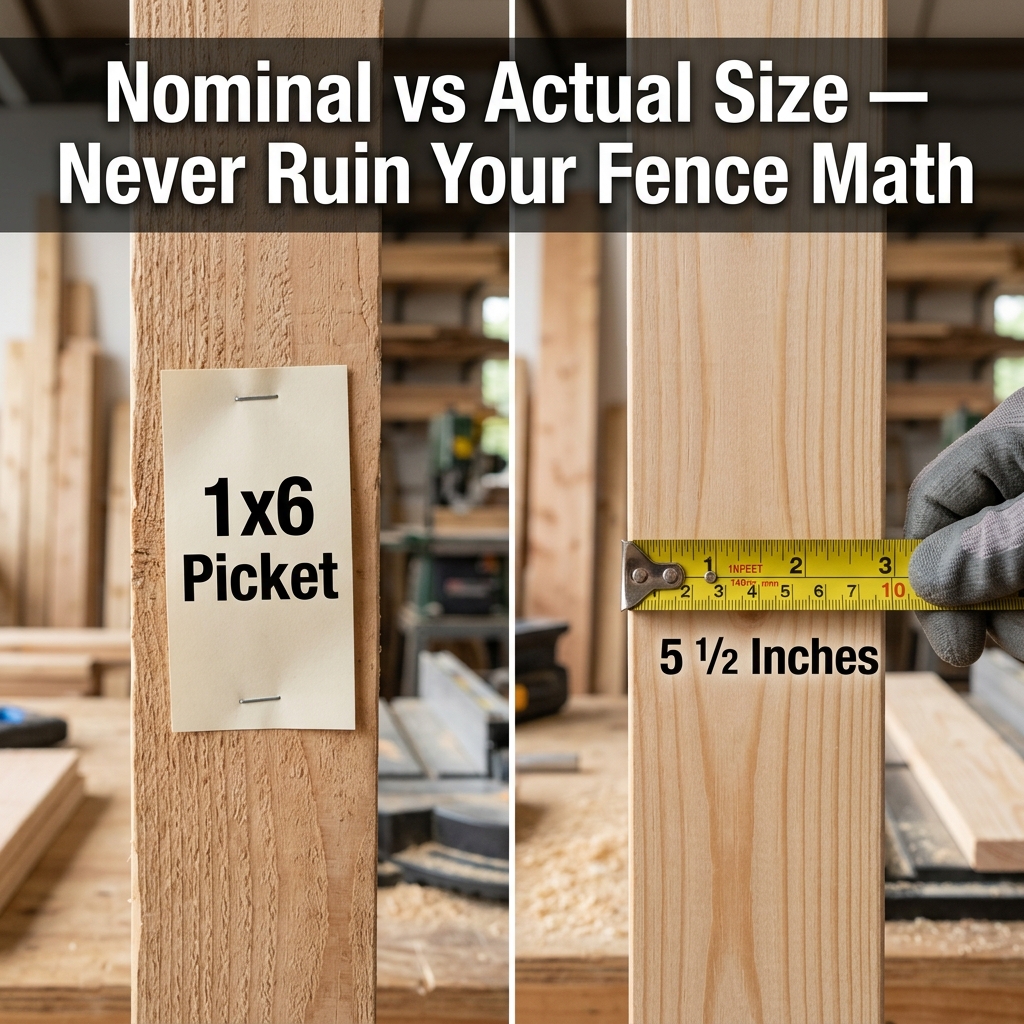
One of the most frequent mistakes homeowners and amateur fence builders make is calculating fence picket quantities using nominal dimensions rather than actual milled dimensions.
In construction, lumber labeled “1x4” or “1x6” is cut to nominal dimensions when wet at the sawmill, but after drying, planing, and surfacing, the finished product is significantly smaller.
Understanding exact standard picket dimensions is crucial for determining how many boards you need, how wide your post gaps will be, and how much your materials will cost.
1. Actual vs Nominal Lumber Dimensions
When buying wood fence pickets from suppliers like The Home Depot, Lowe’s, or local lumberyards, always use actual dimensions in your calculations:
| Nominal Size | Actual Width | Actual Thickness | Typical Material |
|---|---|---|---|
| $1 \times 4$ Picket | $3.5\text{ inches}$ ($89\text{ mm}$) | $0.625\text{ in}$ to $0.75\text{ in}$ ($16-19\text{ mm}$) | Western Red Cedar, Pressure-Treated Pine |
| $1 \times 6$ Picket | $5.5\text{ inches}$ ($140\text{ mm}$) | $0.625\text{ in}$ to $0.75\text{ in}$ ($16-19\text{ mm}$) | Cedar, Treated Southern Yellow Pine, Redwood |
| $1 \times 3$ Picket | $2.5\text{ inches}$ ($64\text{ mm}$) | $0.5\text{ in}$ to $0.625\text{ in}$ ($13-16\text{ mm}$) | Decorative Picket, Gothic Top |
| Vinyl / PVC 3” | $3.0\text{ inches}$ ($76\text{ mm}$) | $0.875\text{ in}$ ($22\text{ mm}$) hollow extrusion | Extruded PVC / Vinyl |
| Aluminum 5/8” | $0.625\text{ inches}$ ($16\text{ mm}$) | $0.625\text{ in}$ square tube | Powder-Coated Aluminum |
[!WARNING] Budget “dog-ear” pickets sold in home centers frequently measure only $5\text{ and } 3/8\text{ inches}$ ($5.375\text{ in}$) wide and $5/8\text{ inch}$ thick instead of a true $5.5\text{ inches}$. Over an 8-foot panel with 14 pickets, that $1/8\text{ inch}$ difference per board creates an unexpected $1.75\text{ inch}$ discrepancy if you do not measure first!
2. Standard Fence Picket Heights
Fence pickets are manufactured in standard lengths designed to meet residential municipal zoning laws and swimming pool barrier requirements:
3-Foot & 4-Foot Pickets (36” – 48”)
- Best For: Front yard boundary fences, decorative garden fences, historic Victorian picket styles.
- Zoning: Most municipalities limit front yard barriers to 42 or 48 inches to maintain sightlines for motorists and pedestrians.
5-Foot Pickets (60”)
- Best For: Medium privacy, pet containment, and transitions along sloped yards.
6-Foot Pickets (72”)
- Best For: Backyard privacy fences, windbreaks, and boundary security.
- Popularity: 6 feet is by far the most widely installed fence height in North America and Western Europe.
8-Foot Pickets (96”)
- Best For: Maximum privacy, commercial perimeters, high-wind sound attenuation, or deer-exclusion barriers.
- Note: 8-foot fences require heavier 4x4 or 6x6 posts buried at least 3 feet deep in concrete, as well as three or four horizontal 2x4 rails to resist wind shear.
3. Picket Top Profiles & Styles
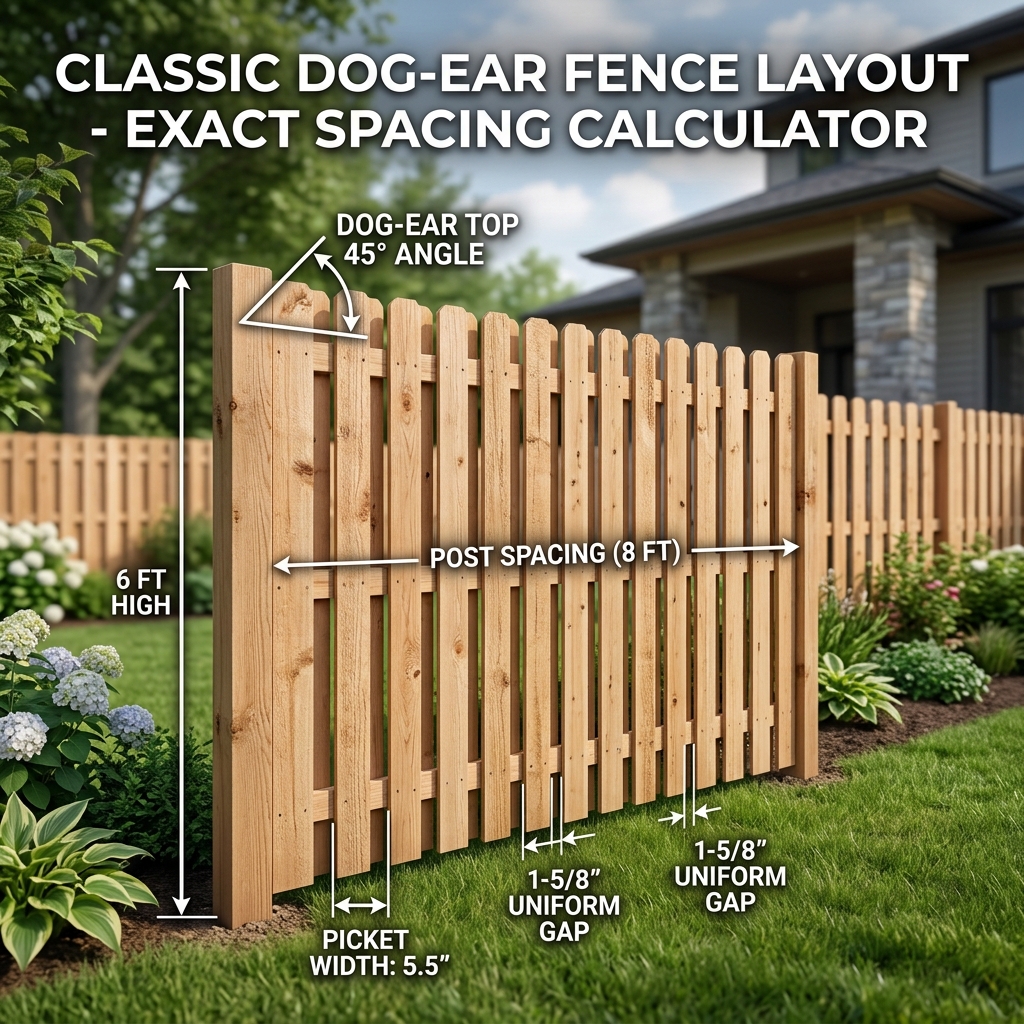
The profile cut into the top of the picket changes both the aesthetic character and water drainage properties of your fence:
- Dog-Ear (Single or Double): Corners clipped at a 45-degree angle. This is the most common and budget-friendly profile. The angled cuts allow rainwater to run off the end-grain, reducing rot.
- Flat Top: Clean, modern contemporary look. Flat tops hold pooling water longer unless capped with a top 2x6 fascia or drip rail.
- French Gothic / Spear: Elegant diamond spear-point top popular in colonial and cottage designs.
- Scalloped / Arched: Pickets are cut along a concave or convex sweeping curve between posts.
 [Dog Ear]      [French Gothic]      [Flat Top]
    /\                /\                +--+
   /  \              /  \               |  |
  /    \            / /\ \              |  |
  |    |            | |  |              |  |
4. How Material Choices Affect Picket Dimensions
Western Red Cedar
- Characteristics: Naturally resistant to decay, termites, and rot due to organic thujaplicin oils.
- Dimensional Stability: Cedar is dimensionally stable; it swells and shrinks less than yellow pine.
- Recommended Thickness: Aim for $5/8\text{ inch}$ minimum; premium clear cedar is usually $11/16\text{ in}$ to $3/4\text{ in}$.
Pressure-Treated Pine (PT Pine)
- Characteristics: Economical and structurally durable, treated with micronized copper azole (MCA) chemicals.
- Shrinkage Factor: Often sold soaking wet (“green”). As it dries over 6–12 months in the sun, boards can shrink by up to $1/4\text{ inch}$ in width and curl if not fastened with at least two or three screws per rail.
Extruded Vinyl / PVC
- Characteristics: Zero maintenance, never rots, and never requires paint or stain.
- Expansion Note: Vinyl pickets expand and contract with temperature swings. Vinyl railing channels use internal notch clips rather than rigid face screws to allow thermal movement.
Plan Your Fence Accurately
When purchasing pickets for your project:
- Always pull a tape measure across the actual boards at the lumberyard.
- Enter your precise measured width into the Fence Picket Calculator along with your post span.
- Add a 5% to 10% waste buffer to account for warped boards, knots, or cracked dog-ears.
- For deep-dive dimensions, see: How Thick Is a Fence Picket? and How Wide Is a Fence Picket?.
- For full construction instructions, check out our master guide: How to Build a Picket Fence: Step-by-Step DIY Installation Guide.